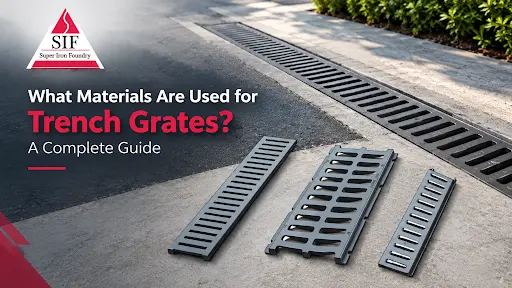
Trench grates are an important part of modern drainage systems. They cover drainage channels while allowing rainwater, wastewater, and surface runoff to enter the drainage system efficiently. Although trench grates may look like simple components, their material, design, load capacity, finish, and manufacturing quality can directly affect the performance and service life of a drainage installation.
Different projects require different materials. A pedestrian walkway may have very different requirements from a busy roadway, industrial facility, parking area, or commercial property. This is why understanding the materials used for trench grates is important before selecting a product.
Materials commonly used for trench grates include cast iron, ductile iron, galvanized steel, stainless steel, and, for certain applications, composite or other engineered materials. Each material has its own characteristics and is selected according to factors such as load, exposure, corrosion resistance, appearance, maintenance, and project requirements.
For project owners, contractors, engineers, and infrastructure developers working with Trench Grates Manufacturers in India, understanding these differences can make the selection process more practical and informed.
The material of a trench grate influences how it performs under real operating conditions. A grate installed in an area with frequent vehicle movement needs sufficient structural strength, while a grate used in a wet or chemically exposed environment may require greater corrosion resistance.
Material selection can also affect the weight of the grate, installation requirements, maintenance needs, appearance, and expected service life. Standards and technical specifications for drainage gratings recognize several material options, including flake graphite cast iron, spheroidal graphite cast iron, cast steel, rolled steel, stainless steel, and other specified materials.
For this reason, choosing a trench grate should not simply be based on price or appearance. The installation environment and expected load should be considered together with the material.
Cast iron is one of the traditional materials used for drainage gratings. It offers good compressive strength and durability, making it suitable for many drainage applications where a strong and robust grate is required.
Cast iron trench grates can be used in infrastructure projects, industrial premises, roads, parking areas, and other locations where durability is important. In India, cast iron drainage gratings are also covered by established Indian standards, including IS 5961 for cast iron gratings used for drainage purposes.
One of the advantages of cast iron is its ability to provide a substantial, rigid structure. It is also well suited to casting intricate shapes and patterns, which gives manufacturers flexibility when producing different grate designs.
At Super Iron Foundry (SIF), cast iron manufacturing forms an important part of our expertise. Our approach focuses on appropriate material selection, controlled casting, dimensional consistency, finishing, and quality inspection to produce drainage components suited to their intended applications.
Cast iron trench grates can be considered for roads, industrial areas, commercial premises, parking zones, drainage channels, and infrastructure projects where the design and load requirements are compatible with cast iron.
However, the exact specification should always be selected according to the expected loading conditions and project requirements rather than assuming that every cast iron grate has the same capacity.
Ductile iron is another important material used for trench drainage applications. Unlike conventional grey cast iron, ductile iron has a different graphite structure that provides greater ductility and toughness.
This makes ductile iron particularly useful in applications where the grate may experience vehicle traffic, impact, or demanding operating conditions. Commercial trench drainage systems are available with ductile iron grates designed for vehicle and heavy-duty applications.
Ductile iron can therefore be considered when a project requires a combination of strength and improved resistance to mechanical impact.
Ductile iron is often considered for areas such as roads, parking facilities, industrial premises, loading zones, and other locations where the drainage grate may experience repeated traffic or higher mechanical loads.
The actual suitability depends on the grate design, dimensions, supporting frame, installation conditions, and certified load classification. A material name alone does not determine the complete performance of a drainage grate.
Galvanized steel is another option for trench drainage systems. In this approach, steel receives a zinc coating to improve its resistance to corrosion.
Galvanized steel can be suitable for commercial, industrial, warehouse, outdoor, and general drainage applications where corrosion protection is important. Technical specifications for drainage grating systems also recognize galvanized steel as a suitable frame or construction material when appropriate corrosion protection is provided.
One benefit of galvanized steel is that it can provide a balance between structural strength and corrosion protection. However, the surrounding environment should always be considered. Exposure to aggressive chemicals, chlorides, or other corrosive conditions may require a different material or protective specification.
Stainless steel is generally selected when corrosion resistance, hygiene, appearance, or demanding environmental conditions are important considerations.
Stainless steel trench grates can be found in applications such as commercial kitchens, food- processing facilities, hospitals, swimming pools, commercial developments, and other environments where regular cleaning or moisture exposure is expected.
Different grades of stainless steel provide different levels of corrosion resistance. For example, 304 and 316 stainless steel are commonly specified for drainage-related applications, with the appropriate grade depending on the environment.
The higher corrosion resistance of stainless steel can make it suitable for specialized applications, although its initial material cost can be higher than some other options.
Not every drainage project requires a metal grate. Certain trench drainage systems also use composite materials or other engineered materials where weight, corrosion resistance, appearance, or application-specific requirements are important.
Composite gratings can provide useful characteristics in selected environments, but their suitability depends heavily on the expected load and installation conditions.
For this reason, project specifications should identify the required load classification and environmental conditions before deciding on a material.
Choosing the right material starts with understanding where the trench grate will be installed.
The first consideration should be the expected traffic and loading conditions. A pedestrian area has different requirements from a roadway used by cars and trucks.
The grate, frame, supporting channel, and installation system should work together to accommodate the expected load. Standards such as EN 1433 classify drainage products according to their intended areas of installation and loading conditions.
Moisture, chemicals, salt, industrial contaminants, and cleaning agents can influence material selection. A material that performs well in an ordinary outdoor environment may not be the right choice for a highly corrosive industrial or marine environment.
Maintenance should also be considered before selecting a material. A drainage grate may need regular cleaning, removal, inspection, or replacement depending on the installation.
The grate design should therefore allow practical access while maintaining the required structural performance.
Material selection cannot be separated from product design. The dimensions, thickness, opening pattern, frame arrangement, and supporting structure all influence the performance of the finished drainage system.
This is where the experience of Trench Grates Manufacturers in India can become valuable. An experienced manufacturer can assess the intended application and help develop a product according to project-specific dimensions and requirements.
Selecting the right material is only one part of producing a reliable trench grate. Manufacturing quality also plays a major role.
Casting consistency, dimensional accuracy, surface finishing, machining, inspection, and quality control can all affect the final product. A technically suitable material can still result in an unsuitable grate if the manufacturing process does not maintain the required dimensions and structural quality.
At Super Iron Foundry (SIF), we understand that drainage products need to perform in practical site conditions, not just meet an initial specification. Our manufacturing approach combines foundry experience with quality-focused production and inspection.
For projects requiring customized dimensions or specific design requirements, communication between the manufacturer, contractor, consultant, and project team is equally important. Clear technical specifications help ensure that the final product matches the actual installation requirements.
India has a wide range of infrastructure and construction requirements, from urban drainage networks and highways to industrial facilities, commercial developments, and residential projects. These applications can have significantly different loading and environmental conditions.
Working with experienced Trench Grates Manufacturers in India can help project teams evaluate material, dimensions, design, load requirements, and finishing options before production.
Super Iron Foundry (SIF) manufactures trench grate solutions with a focus on durability, practical application, dimensional consistency, and quality. Our experience in iron casting enables us to understand the relationship between material selection, product design, and manufacturing performance.
Rather than selecting a grate based only on its appearance, it is important to consider the complete application. The right material and design combination can contribute to reliable drainage performance and longer service life.
Trench grates are available in several materials, with cast iron, ductile iron, galvanized steel, and stainless steel among the commonly considered options. Each material has different characteristics, and no single material is automatically suitable for every project.
Cast iron can be a practical choice for many durable drainage applications, while ductile iron may be preferred where greater toughness and demanding loading conditions are involved. Galvanized steel can provide useful corrosion protection, whereas stainless steel is often considered for environments where hygiene and corrosion resistance are priorities.
The most suitable choice ultimately depends on the installation environment, expected loading, drainage requirements, dimensions, maintenance needs, and applicable specifications.
By working with experienced Trench Grates Manufacturers in India such as Super Iron Foundry, project teams can evaluate these factors more effectively and select drainage solutions designed around the actual requirements of the application.
Common materials include cast iron, ductile iron, galvanized steel, and stainless steel. Composite and other engineered materials may also be used for specific applications. The appropriate material depends on load, environment, corrosion exposure, design, and project requirements.
Cast iron can be suitable for many demanding drainage applications when the grate is correctly designed, manufactured, supported, and specified for the expected load. The actual load classification and installation conditions should always be checked before selection.
Both are iron-based materials, but their mechanical characteristics differ. Ductile iron is designed to provide greater ductility and toughness than conventional grey cast iron, which can make it suitable for applications involving higher impact or demanding traffic conditions.
Consider the expected load, traffic conditions, installation environment, corrosion exposure, drainage requirements, dimensions, maintenance needs, and applicable standards. Consulting an experienced manufacturer can also help match the material and design to the project.
Yes. Depending on the manufacturer and production capabilities, trench grates can be manufactured according to required dimensions, designs, patterns, and technical specifications. Super Iron Foundry (SIF) provides trench grate solutions for different application and project requirements.