
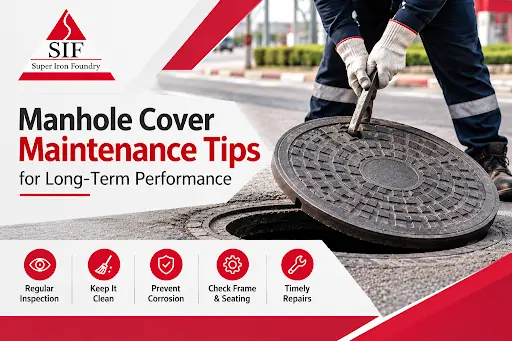
Regular maintenance plays an important role in keeping manhole covers safe, durable, and functional over time. Whether installed on busy roads, residential streets, industrial premises, or commercial properties, manhole covers are constantly exposed to traffic loads, changing weather conditions, moisture, and everyday wear. Without proper inspection and maintenance, even a well-manufactured cover may develop problems that affect its performance and service life.
For infrastructure owners, contractors, and municipal authorities, understanding the right maintenance practices can help reduce avoidable damage, improve public safety, and control long-term replacement costs. Choosing quality products from reliable Manhole Covers Manufacturers in India is also an important part of ensuring dependable performance under the intended operating conditions.
At Super Iron Foundry, we recognise the importance of durable iron castings in modern infrastructure. By understanding how material quality, installation, inspection, and routine care work together, buyers and maintenance teams can make more informed decisions about the manhole covers used in their projects.
Manhole covers provide access to underground drainage systems, sewer networks, utility chambers, and other essential infrastructure. They also help protect these openings from unauthorised access, debris, and accidental falls when properly selected and installed.
Over time, environmental exposure and repeated loading can affect the condition of both the cover and its supporting frame. Heavy vehicles may place significant stress on covers installed on roadways, while standing water and corrosive substances can contribute to surface deterioration. Covers that are not seated correctly may also move, rattle, or become unstable.
Routine maintenance helps identify these issues before they develop into more serious problems. It can also help maintenance teams determine whether a cover requires cleaning, adjustment, professional repair, or complete replacement.
The key is to treat maintenance as an ongoing responsibility rather than waiting until a cover becomes visibly damaged.
Manhole covers installed on roads, parking areas, and industrial sites may experience repeated pressure from cars, buses, trucks, and other vehicles. If a cover is not designed for the expected load, excessive stress can cause cracking, deformation, or damage to its supporting frame.
Selecting a cover with an appropriate load rating is therefore essential. Maintenance teams should pay particular attention to covers in high-traffic locations and inspect them for visible cracks, unusual movement, or changes in their seating position.
The intended application should always guide product selection. A cover suitable for a pedestrian walkway may not be appropriate for a road carrying heavy commercial vehicles.
Rainfall, humidity, standing water, and exposure to certain chemicals can affect the condition of metal components. The extent of deterioration depends on the material, manufacturing quality, environmental conditions, and protective measures used.
In areas that experience heavy monsoon rainfall, regular checks are particularly useful for identifying water accumulation, damaged surfaces, and drainage problems around the frame. Keeping the surrounding area clear can help prevent debris from obstructing drainage pathways.
Where corrosion or material deterioration is present, the affected component should be assessed to determine whether maintenance is sufficient or replacement is necessary.
Even durable Manhole Covers can experience problems when installation is not carried out correctly. An uneven supporting surface, an improperly fitted frame, or an incorrectly positioned cover can result in rocking, noise, and uneven load distribution.
The frame should be securely supported and installed according to the product specifications and site requirements. Any cover that sits unevenly, shifts under normal conditions, or produces repeated impact noise should be inspected by a qualified professional.
Correct installation is just as important as selecting a suitable product.
Regular visual inspections are one of the simplest ways to identify maintenance requirements early. Check the cover and frame for visible cracks, chips, corrosion, unusual movement, loose fittings, and signs of uneven seating.
It is also important to check whether the cover sits level with the surrounding road or pavement. Differences in height can create hazards for pedestrians and vehicles, while a loose cover may become unstable under repeated traffic loads. India’s sewer operation and maintenance guidance identifies wear, damage, movement, and differences between cover and road-surface levels as important inspection points.
The inspection frequency should reflect the location, traffic volume, environmental conditions, and previous maintenance history. Covers in busy roads or areas prone to flooding may require more frequent attention than those in low-traffic locations.
Dirt, leaves, mud, plastic waste, and other debris can collect around manhole covers, particularly during the rainy season. If this material blocks nearby drainage channels, water may accumulate around the frame and contribute to deterioration of the surrounding surface.
Routine cleaning helps maintenance teams identify developing problems and maintain proper drainage around the installation. The cover’s seating area should also remain free from accumulated debris that could prevent the cover from fitting correctly.
Cleaning should be carried out using suitable tools and safe procedures. Workers should never attempt to lift a heavy cover without the correct lifting equipment and appropriate precautions.
Small signs of surface deterioration should not be ignored. Depending on the material and severity, appropriate maintenance may involve cleaning, an approved protective coating, or assessment by a qualified professional.
Protective treatments must be compatible with the cover’s material and intended use. They should not interfere with the seating surfaces, locking mechanisms, lifting points, or other functional features.
If a cover shows deep corrosion, structural cracking, significant deformation, or a loss of load- bearing integrity, surface treatment alone will not resolve the underlying problem. In such cases, replacement may be necessary.
The frame supports the cover and helps distribute loads to the surrounding structure. Even when the cover itself appears to be in good condition, a damaged or poorly supported frame can compromise the entire installation.
During maintenance, inspect the frame for movement, cracks, uneven seating, and deterioration of the surrounding concrete or pavement. Any instability should be assessed before the area is returned to normal use.
A replacement cover must be compatible with the existing frame in terms of dimensions, seating arrangement, and intended application. Mixing incompatible components can cause rocking, poor alignment, and premature wear.
Manhole covers can be heavy, and improper handling may damage their edges, lifting points, or supporting frames. It can also expose workers to serious injury.
Use suitable lifting keys or other approved tools designed for the particular cover. Avoid striking the cover forcefully to remove it, dragging it across hard surfaces, or dropping it into the frame during reinstallation.
After maintenance work, ensure the cover is seated securely and that any locking or other safety features operate as intended. The surrounding area should be checked before traffic or pedestrian access resumes.
Maintenance should not stop at identifying a problem. Any defect affecting safety or structural performance needs timely attention.
A cover that rocks, has a visible crack, sits unevenly, or cannot be secured properly should be assessed promptly. Where an immediate hazard exists, the area should be isolated and protected in accordance with the site’s safety procedures until corrective action is completed.
Repairs should be undertaken only where they are technically appropriate. If the cover or frame no longer meets the requirements of its application, replacement with a correctly specified product is the more suitable approach.
Maintenance practices can help preserve a manhole cover, but they cannot compensate for unsuitable materials, incorrect load ratings, or poor manufacturing quality.
Different locations require different cover specifications. A pedestrian area, residential driveway, industrial facility, and busy roadway may all have different loading and environmental requirements.
Before purchasing, buyers should consider the expected traffic load, opening dimensions, material properties, exposure to moisture, and any project-specific requirements. Cast iron and ductile iron covers may be suitable for different applications depending on their design and verified performance characteristics.
Product selection should be based on documented specifications and applicable standards rather than appearance or price alone. For relevant projects, buyers can review the applicable Indian Standard, including IS 1726 for cast iron manhole covers and frames, and confirm the requirements with the manufacturer or project engineer.
Established Manhole Covers Manufacturers in India can help buyers understand product specifications, material options, dimensional requirements, and suitability for different infrastructure applications.
When evaluating a supplier, ask for relevant product drawings, load classifications, test documentation, material details, and installation guidance. The information provided should match the specific product being purchased.
For projects in eastern India, buyers may also evaluate Manhole Covers Manufacturers in West Bengal based on manufacturing capabilities, product consistency, quality-control processes, and their ability to meet project requirements.
At Super Iron Foundry (SIF), our focus is on iron casting and infrastructure-related products. We understand that dependable castings require attention to material selection, manufacturing processes, and the requirements of the intended application. For buyers considering manhole covers, checking the specifications and suitability of the proposed product is an important step towards long-term performance.
In regions such as West Bengal, monsoon conditions can bring heavy rainfall, waterlogging, and an increased accumulation of roadside debris. Before the rainy season, maintenance teams should inspect covers, frames, nearby drainage routes, and surrounding pavement for visible damage.
Blocked drainage pathways should be cleared using appropriate procedures, and loose or uneven covers should be assessed before heavy rainfall begins. After periods of intense rain, another inspection can help identify displacement, erosion around frames, or damage caused by water and traffic.
Dry periods offer an opportunity to identify issues that may be harder to assess during heavy rainfall. Maintenance teams can check for cracks in the surrounding pavement, deteriorating frame supports, loose fittings, and signs of wear that may have developed over time.
Any protective coating or repair work should be carried out according to the product requirements and suitable environmental conditions. Maintaining a record of inspections, repairs, and replacements can also help teams plan future maintenance more effectively.
One common mistake is waiting until a cover breaks before arranging an inspection. Small signs of movement, surface deterioration, or uneven seating can indicate developing problems that deserve attention.
Another mistake is selecting a replacement based only on its dimensions or purchase price. The cover must also be suitable for the expected load and compatible with the frame. Similarly, applying an unsuitable coating or carrying out improvised repairs may conceal visible damage without resolving the underlying structural issue.
Finally, safety should never be overlooked. Manhole openings can expose workers to falls, hazardous gases, oxygen deficiency, and other risks. Inspection or cleaning that involves opening a chamber or entering a confined space must follow appropriate safety procedures, including traffic management and confined-space precautions where applicable.
Long-term manhole cover performance depends on several connected factors, including material quality, suitable load capacity, correct installation, regular inspections, and timely maintenance. Although no cover can remain in service indefinitely, a planned maintenance approach can help identify defects early and reduce avoidable disruption.
For infrastructure owners and contractors, selecting products that meet the needs of the installation is just as important as maintaining them after installation. Evaluating reliable Manhole Covers Manufacturers in India and checking the relevant product specifications can help buyers make informed purchasing decisions. Similarly, comparing the capabilities of Manhole Covers Manufacturers in West Bengal can help project teams identify suppliers suited to their requirements.
At Super Iron Foundry (SIF), we recognise the role that quality iron castings play in dependable infrastructure. By combining appropriate product selection with responsible installation and regular inspection, project owners can support safer operation and more reliable performance throughout the service life of their manhole covers.
Inspection frequency depends on traffic levels, environmental conditions, the type of installation, and previous maintenance findings. High-traffic roads and areas prone to flooding may require more frequent inspections. Any visible damage, movement, or uneven seating should be assessed promptly.
Common warning signs include cracks, corrosion, unusual noise, loose seating, damaged lifting points, uneven positioning, and deterioration around the supporting frame. Covers showing signs of structural damage should be assessed by a qualified professional.
Yes, appropriate maintenance can help reduce avoidable deterioration and identify problems before they become more serious. However, maintenance cannot compensate for an unsuitable load rating, defective materials, or structural damage that requires replacement.
Buyers should assess material specifications, load capacity, dimensional accuracy, relevant testing documentation, quality-control procedures, and suitability for the intended application. Installation guidance and the supplier’s ability to meet project specifications are also important considerations.
Considering manufacturers in West Bengal may be useful for projects in the region because it can simplify supplier communication, coordination, and logistics. Buyers should still evaluate each manufacturer’s product specifications, quality processes, and ability to meet the project’s technical requirements.