
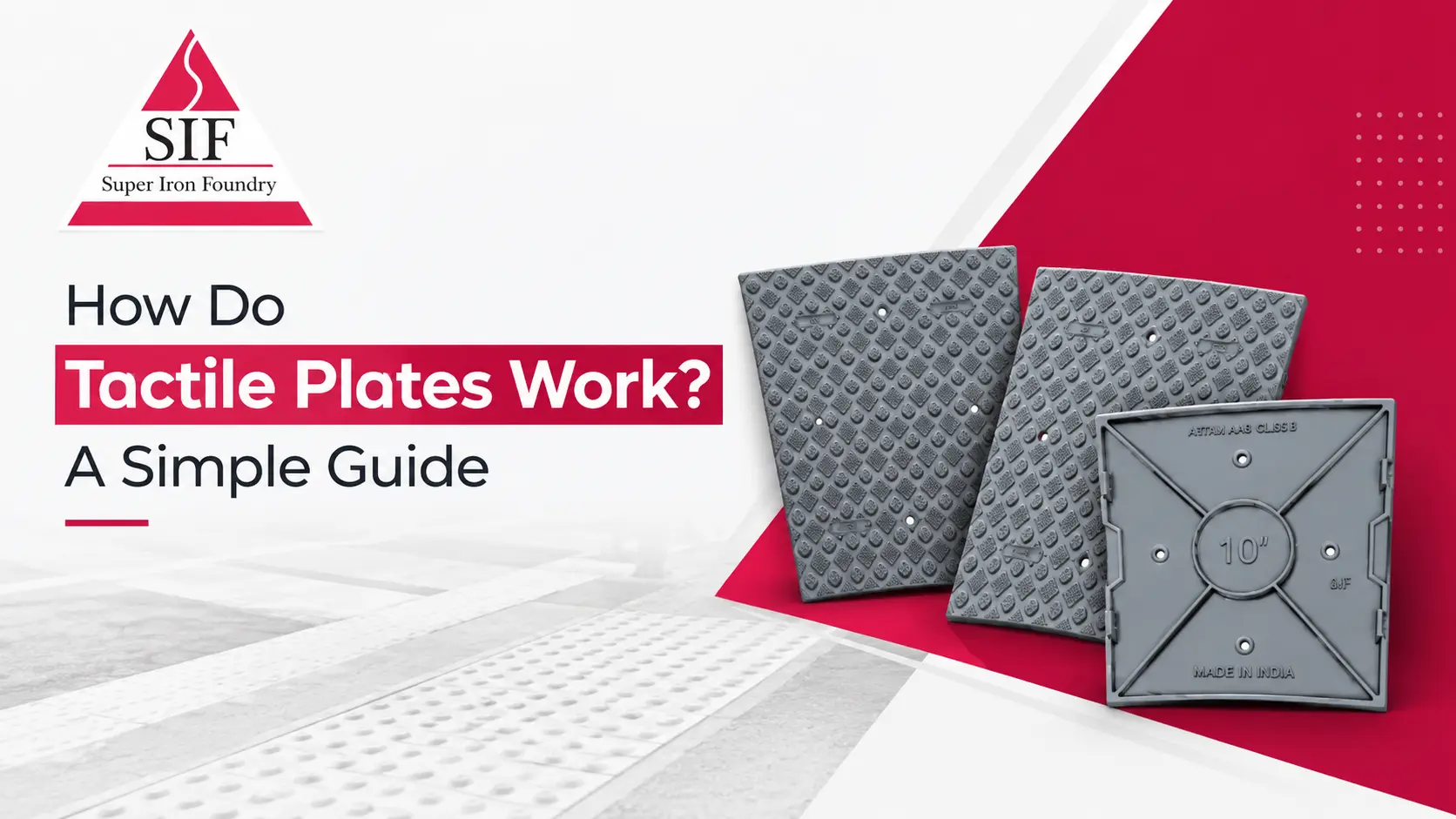
Tactile plates are an important part of accessible infrastructure. They help people with visual impairments understand their surroundings and navigate public spaces more independently. You can find them in places such as railway stations, metro platforms, pedestrian walkways, shopping centres, airports, public buildings, and other high-traffic areas.
But how do tactile plates actually work? In simple terms, they use raised patterns or surfaces that can be detected through touch, particularly with a white cane or underfoot. These patterns provide information about a person’s surroundings, helping indicate a change in direction, a potential hazard, or the edge of a particular area.
As accessibility becomes an increasingly important consideration in modern infrastructure, understanding how tactile plates work can help architects, contractors, infrastructure developers, and property owners make more informed choices.
A tactile plate is an accessibility product designed to provide physical guidance or warning through a raised surface. Unlike conventional flooring, tactile plates have deliberately designed patterns that can be felt through touch.
These raised patterns generally serve two primary purposes. Some are intended to provide directional guidance, while others are designed to warn users about hazards or changes in the surrounding environment.
The basic idea is straightforward: instead of relying entirely on visual signs, tactile information allows people to receive important environmental cues through physical contact.
Tactile plates work by creating a detectable change in the surface of a walkway or floor. Their raised patterns can be identified by a person using a mobility cane or, depending on the application, by the person’s feet.
When someone encounters a tactile surface, the change in texture communicates information about the surrounding environment. A particular pattern may indicate that the person is approaching a platform edge, crossing point, staircase, roadway, or another area that requires additional attention.
The effectiveness of a tactile plate depends on several factors, including its pattern, dimensions, placement, surface texture, visibility, durability, and the environment where it is installed. This combination of physical and visual information makes tactile plates an important accessibility feature in public infrastructure.
One of the most common questions about tactile plates is whether all tactile surfaces serve the same purpose. They do not.
Directional tactile plates are generally used to help guide movement along a particular route. Their pattern provides a continuous tactile indication that can help a person understand where a designated accessible path is located.
Warning tactile plates, on the other hand, are used to communicate that a person is approaching a potential hazard or significant change in the environment. They may be installed near platform edges, pedestrian crossings, stairways, or other locations where additional awareness is required.
The pattern and placement therefore play a major role in communicating the intended message.
Tactile plates are commonly installed in public and commercial environments where accessibility and pedestrian safety are important considerations.
Railway stations and metro systems are particularly common applications. Tactile surfaces can help passengers identify platform edges and navigate designated pedestrian routes. Airports, bus terminals, hospitals, educational institutions, shopping centres, government buildings, and public footpaths can also benefit from tactile accessibility systems.
In outdoor environments, tactile plates need to withstand regular pedestrian traffic as well as exposure to weather and other environmental conditions. For this reason, material selection and manufacturing quality are important considerations when specifying a product.
Accessibility is not simply about providing physical entry into a building. It is also about enabling people to move through an environment with greater confidence and independence.
Tactile plates provide information that may not always be available through conventional signs. A person with limited or no vision can use tactile information to understand changes in the walking surface and identify specific areas of a route.
For infrastructure planners and developers, incorporating tactile systems into a project can therefore contribute to a more inclusive environment.
Tactile plates can be manufactured from different materials depending on the intended application. Metal is often considered for projects where strength, durability, and resistance to regular pedestrian traffic are important.
The right material depends on where the tactile plate will be installed and what environmental conditions it will encounter. Indoor applications may have different requirements from outdoor public infrastructure, while railway and metro projects can demand products capable of handling heavy and continuous use.
A reliable manufacturer should be able to recommend an appropriate material and finish based on the project’s technical requirements.
Choosing a tactile plate is about more than simply selecting a product with a raised pattern. The product should be suitable for its intended environment and application.
Durability is an important consideration, particularly in railway stations, metro systems, public walkways, and other high-footfall locations. The surface should also provide a clear tactile distinction while maintaining appropriate visual contrast where required by the project.
Installation requirements, dimensions, pattern design, material quality, surface finish, and resistance to environmental conditions should also be considered before making a selection.
Working with experienced manufacturers can make this process easier because they can help match the product to the requirements of a specific project.
Railway and metro environments can be challenging for pedestrians because of high foot traffic, complex layouts, moving trains, and platform edges. Tactile systems help introduce additional physical cues into these environments.
On platforms, warning tactile surfaces can help identify areas where passengers need to exercise additional caution. Directional tactile surfaces can also support movement along designated pedestrian routes.
For large infrastructure projects, consistency is particularly important. Tactile plates need to be manufactured to appropriate specifications so that the installed system provides a predictable experience across different areas of the project.
When sourcing accessibility products for projects in Canada, buyers should consider more than price alone. The manufacturer should understand the requirements of the intended application and be capable of producing consistent, durable products.
Experienced Tactile Plate Manufacturers in Canada can support projects by providing products suited to public infrastructure, transportation facilities, commercial spaces, and other accessibility-focused applications.
Product quality, manufacturing consistency, material selection, customization capabilities, and project support are all worth considering when evaluating a supplier.
The same principles apply when sourcing tactile products for projects in the United States. Infrastructure projects can involve different environmental conditions, installation requirements, and project specifications, making product selection an important part of the planning process.
Working with established Tactile Plate Manufacturers in USA can help project teams source products designed for demanding public and commercial environments.
At Super Iron Foundry, we understand that accessibility products need to combine practical functionality with dependable manufacturing. Our experience in metal casting and manufacturing allows us to approach tactile products with a focus on material quality, precision, durability, and application requirements.
A tactile plate may appear simple, but its effectiveness depends on how accurately it is manufactured. Raised patterns need to be consistent, dimensions need to remain within the required specifications, and the finished surface needs to be appropriate for its intended use.
Manufacturing quality also becomes more important when products are being installed across a large infrastructure project. Small differences between individual units can affect the consistency of the completed tactile pathway.
This is why buyers should evaluate the manufacturer’s production capabilities, quality-control practices, material selection, and experience before placing an order.
Tactile plates work by transforming important environmental information into physical signals that can be detected through touch. Their raised patterns can help people identify routes, changes in level, hazards, and other important features within a built environment. From railway stations and metro platforms to public walkways and commercial buildings, tactile systems play a valuable role in creating more accessible spaces.
For project owners and infrastructure developers, choosing the right tactile product means considering its material, design, durability, application, installation requirements, and manufacturing quality. Whether sourcing from Tactile Plate manufacturers in Canada or Tactile Plate manufacturers in USA, selecting an experienced and dependable manufacturing partner can make a significant difference to the long-term performance of an accessibility project.
Super Iron Foundry focuses on dependable metal manufacturing solutions designed around practical project requirements, helping customers source products where consistency, durability, and precision matter.
Tactile plates provide physical information through raised patterns and surfaces. These patterns can be detected using a mobility cane or through foot contact, helping users identify routes, hazards, boundaries, and changes in the surrounding environment.
The main purpose of a tactile plate is to provide accessible physical information. Depending on its design and placement, it can guide pedestrians along a route or warn them about a potential hazard or change in the environment.
Tactile plates are commonly used in railway stations, metro platforms, airports, pedestrian walkways, public buildings, shopping centres, hospitals, educational institutions, and other areas where accessible navigation is important.
Yes, tactile plates can be designed for outdoor applications. However, the material, surface finish, durability, and installation method should be selected according to the environmental conditions and expected pedestrian traffic.
Consider the manufacturer’s material expertise, production capabilities, quality-control processes, dimensional consistency, customization options, experience with infrastructure projects, and ability to meet the technical requirements of your application.
Not necessarily. Tactile plates are individual manufactured units that provide tactile information, while tactile paving is a broader term for accessible surfaces or systems incorporating tactile patterns. The exact terminology can vary depending on the project and application.
Depending on the manufacturer and project requirements, tactile plates may be available with different dimensions, patterns, materials, finishes, and installation configurations. Customization should be discussed with the manufacturer before production.
Material selection affects the product’s durability, surface performance, resistance to environmental conditions, maintenance requirements, and suitability for the intended application. High-traffic outdoor and transportation projects may require more robust material solutions than low-traffic indoor applications.