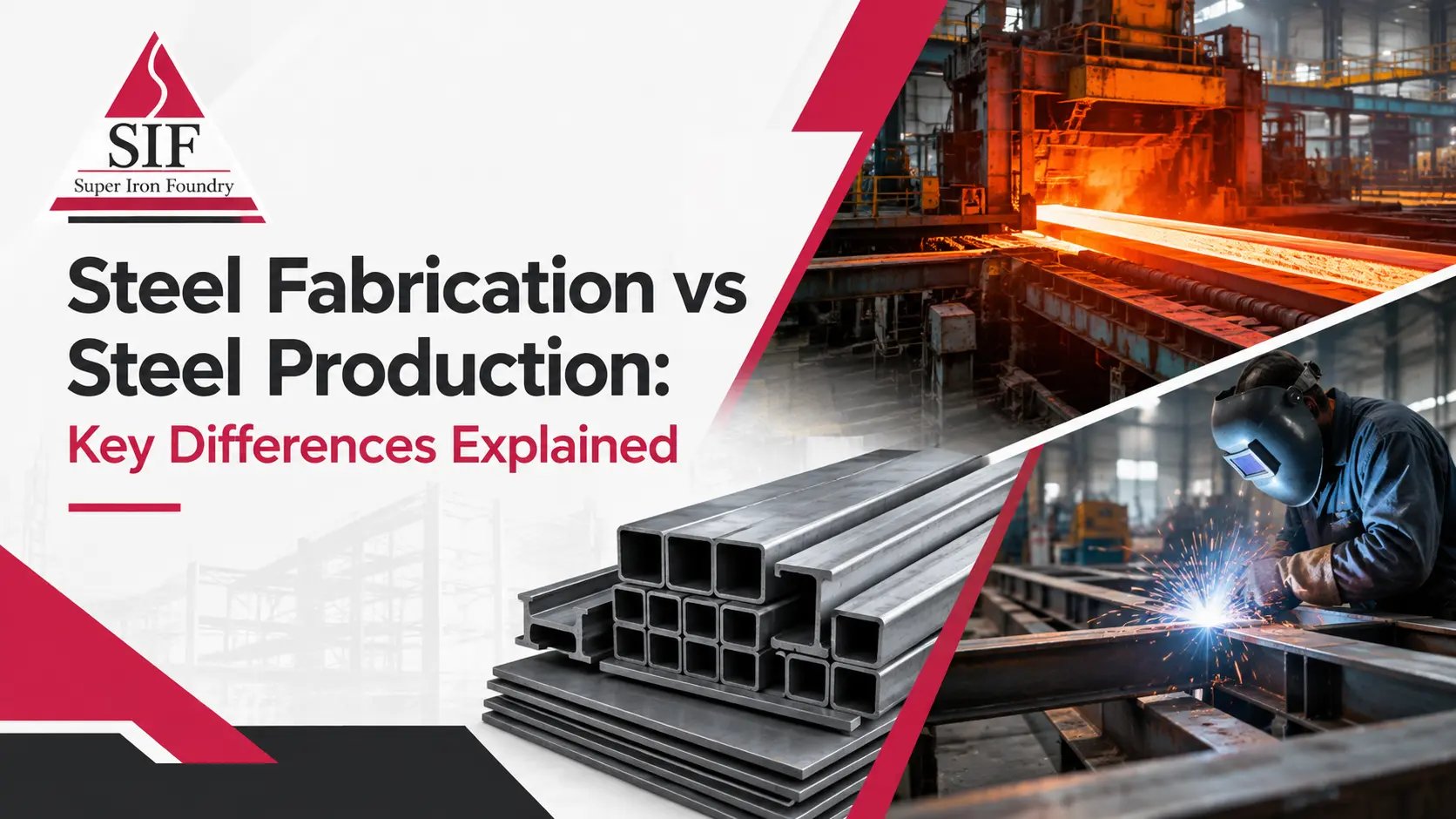
Steel plays an essential role in modern construction, infrastructure, manufacturing, transportation, and industrial development. However, the terms steel production and steel fabrication are sometimes used interchangeably, even though they describe very different stages of working with steel.
Understanding this distinction can help businesses, contractors, engineers, and project planners choose the right manufacturing process for their requirements. Steel production generally focuses on creating steel material from raw resources or processing existing steel into usable forms, while fabrication transforms steel into specific components, structures, or finished products.
At Super Iron Foundry (SIF), we understand that selecting the appropriate steel solution requires attention to material quality, dimensional accuracy, application requirements, and production capabilities. This article explains how steel production and fabrication differ, how they complement each other, and why choosing an experienced manufacturing partner matters.
Steel manufacturing refers to the industrial processes used to produce steel material and prepare it for further use. Depending on the production method and product requirements, steel can be produced and processed into different forms such as sheets, plates, bars, sections, coils, and other standard shapes.
The manufacturing stage involves controlled processes designed to achieve specific material properties. Factors such as chemical composition, temperature control, mechanical properties, surface condition, and dimensional consistency can influence the final quality of steel.
Modern steel manufacturing relies on advanced equipment, process monitoring, testing, and quality-control procedures. The objective is to produce steel with characteristics suitable for subsequent applications, including construction, infrastructure, engineering, automotive production, and industrial manufacturing.
Steel production therefore represents a foundational stage in the broader steel supply chain. The material produced at this stage can later be cut, formed, joined, machined, or otherwise processed according to the requirements of a particular project.
Steel fabrication is the process of converting steel materials into components or finished products designed for a particular application. Instead of primarily creating the steel itself, fabrication focuses on shaping and assembling available steel into a required design.
Depending on the project, fabrication can involve processes such as cutting, bending, drilling, forming, machining, welding, and finishing. These operations allow manufacturers to produce components with specific dimensions, shapes, configurations, and functional characteristics.
Fabrication requires careful interpretation of technical drawings and specifications. Accurate measurements, appropriate material selection, controlled welding procedures, suitable equipment, and inspection processes can all contribute to the reliability of the finished product.
Fabricated steel products can be used across construction, industrial facilities, transportation infrastructure, drainage systems, utility networks, and other applications where customized or application-specific components are required.
For businesses sourcing customized components, working with experienced fabricated steel product Manufacturers in USA or fabricated steel product Manufacturers in Canada can provide access to products designed around project-specific requirements.
The primary difference between steel production and fabrication lies in their purpose and position within the manufacturing process.
Steel production focuses on producing and processing steel as a material. Fabrication, on the other hand, takes steel material and converts it into a usable component or product.
The two processes can also differ in their equipment and production objectives. Steel production may involve large-scale industrial systems designed for material processing and standard product output. Fabrication generally relies on equipment such as cutting machines, presses, bending systems, welding equipment, machining tools, and inspection instruments.
Another important difference is customization. Steel production commonly creates materials according to established specifications and product dimensions, whereas fabrication allows manufacturers to produce components according to drawings, measurements, engineering specifications, and application requirements.
Quality control is important at both stages, although the inspection criteria can vary. Steel production may emphasize chemical composition, mechanical properties, dimensions, and material consistency. Fabrication may additionally focus on weld quality, dimensional accuracy, surface finish, assembly quality, and conformity with project drawings. Understanding these differences helps buyers identify whether they need raw or processed steel material, fabricated components, or a combination of both.
Steel production and fabrication are not competing processes. In many applications, they are interconnected stages of the same supply chain.
Steel production provides the material required for fabrication. Fabricators then process that material into components that can be installed, assembled, or incorporated into a larger system.
For example, a construction project may require steel sections or plates produced to specific material standards. A fabrication facility can then cut and modify those materials to create structural components suited to the project’s drawings and dimensions.
This relationship makes coordination between material suppliers, fabricators, engineers, contractors, and project managers important. Consistent material specifications and accurate fabrication can help reduce compatibility issues and improve production efficiency.
For specialized infrastructure products, the process may also involve casting, machining, fabrication, coating, and inspection depending on the product design and material requirements. SIF focuses on manufacturing and supplying engineered metal products with attention to application requirements and quality considerations.
Steel manufacturing and fabrication support a wide range of industries because steel combines strength, versatility, durability, and adaptability.
In construction, fabricated steel can be used for structural components, supports, frames, platforms, access systems, and other engineered applications. Manufacturing provides the steel materials required for these components.
Infrastructure projects also depend on fabricated and manufactured metal products. Drainage systems, utility networks, transportation infrastructure, industrial facilities, and municipal projects can require components produced to specific dimensions and load requirements.
Industrial applications can include equipment supports, machine components, brackets, enclosures, platforms, and customized assemblies. The exact fabrication method depends on the material, design, operating environment, required tolerances, and intended service conditions.
The increasing demand for application-specific products has also made reliable fabrication capabilities important for businesses operating across North American markets. Companies evaluating fabricated steel product Manufacturers in USA or fabricated steel product Manufacturers in Canada should consider whether a supplier can consistently meet their technical specifications and production requirements.
Construction projects rarely rely exclusively on standard steel products. Many applications require components that fit particular dimensions, layouts, load conditions, and installation requirements.
Steel fabrication makes this possible by allowing manufacturers to transform steel into application-specific components. Proper fabrication can help ensure that individual components correspond with project drawings and can be integrated efficiently during installation.
Precision is particularly important in structural and industrial applications. Inaccurate dimensions or poorly executed joining work can create installation challenges and potentially affect the performance of an assembly.
Fabrication also supports project flexibility. Engineers and contractors can specify dimensions, configurations, connection points, and other characteristics based on the needs of a particular project rather than relying entirely on off-the-shelf components.
At the same time, fabrication quality depends on more than simply having modern machinery. Skilled personnel, process controls, material traceability where required, inspection procedures, and adherence to relevant specifications all contribute to consistent results.
Choosing a fabrication partner requires more than comparing product prices. Businesses should first determine whether a manufacturer has the capabilities needed for their particular application.
Experience with similar products and industries can be valuable because different applications have different material, dimensional, finishing, and performance requirements. Buyers should also consider manufacturing capacity, quality-control practices, technical communication, production consistency, and the ability to work from engineering drawings or detailed specifications.
Clear communication is another important consideration. A capable supplier should be able to understand project requirements and communicate about materials, dimensions, tolerances, finishing, inspection, and delivery expectations.
Businesses sourcing from international manufacturers should also evaluate documentation, export experience, packaging practices, and the supplier's ability to maintain consistent product specifications across orders.
Super Iron Foundry (SIF) works with a focus on engineered metal products and industrial applications. By combining manufacturing knowledge with attention to product requirements, SIF aims to support customers looking for dependable solutions for infrastructure and industrial projects.
Steel production and steel fabrication represent different but closely connected stages of the steel industry. Production focuses on creating and processing steel materials, while fabrication transforms those materials into components and products designed for specific applications.
Recognizing the difference can help project managers, engineers, contractors, and procurement teams make more informed sourcing decisions. Whether a project requires structural components, infrastructure products, industrial parts, or customized metal solutions, the quality of both the material and the fabrication process can influence the final result.
For businesses evaluating suppliers, factors such as technical capability, quality-control procedures, manufacturing experience, customization options, and application knowledge should be considered alongside cost.
Super Iron Foundry (SIF) supports industrial and infrastructure requirements through its manufacturing capabilities and focus on quality-oriented metal products.
Yes. Steel fabrication can be adapted to project-specific dimensions, configurations, drawings, and functional requirements. The level of customization depends on the manufacturer’s equipment, technical capabilities, and production processes.
In most conventional supply chains, steel material is produced or processed before it reaches the fabrication stage. Fabricators then convert the material into components or finished products according to the required specifications.
Businesses should consider manufacturing experience, technical capabilities, quality-control procedures, production capacity, material knowledge, customization capabilities, inspection practices, and the supplier’s ability to meet project specifications consistently.
Yes. Fabricated steel products are widely used in infrastructure because they can be manufactured according to specific dimensions, designs, loading requirements, and installation conditions.
International buyers can review a supplier's manufacturing capabilities, quality procedures, product specifications, technical documentation, previous experience, communication practices, packaging standards, and ability to support export requirements before placing an order.