
Accessible public infrastructure is about more than creating convenient spaces. It is about making sure people can move through those spaces safely and independently. Tactile warning plates are an important part of this approach, particularly at locations where pedestrians need to identify a hazard, change in level, transit platform, crossing, or other area requiring additional attention.
Among the different materials available for tactile walking surface indicators, cast iron is widely considered for projects where durability and long-term outdoor performance are important. Its strength, resistance to impact, and suitability for demanding public environments make it a practical option for sidewalks, transit facilities, commercial developments, and municipal infrastructure.
For contractors, architects, municipalities, and infrastructure developers looking for reliable accessibility products, working with experienced Tactile Plate manufacturers in Canada can help ensure that the selected product is suitable for the project environment and installation requirements.
Super Iron Foundry (SIF) manufactures ductile iron tactile plates for infrastructure applications and supplies customers internationally, including projects serving the Canadian market.
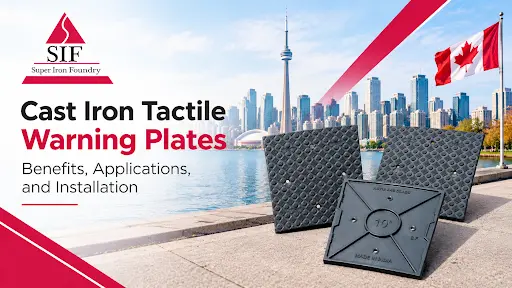
Cast iron tactile warning plates are ground-surface indicators featuring raised patterns that can be detected through touch underfoot or with a mobility cane. Their purpose is to provide information about a potential hazard or change in the pedestrian environment.
Under CSA/ASC B651, tactile walking surface indicators include tactile attention indicators, which use truncated domes to signal caution, and tactile direction indicators, which use elongated bars to assist with wayfinding.
Cast iron plates can be manufactured with these raised patterns and incorporated into pedestrian surfaces such as concrete sidewalks, curb ramps, transit areas, and other accessible routes.
The material is particularly suitable for outdoor applications because cast iron provides a combination of strength and durability that can be valuable in areas exposed to regular pedestrian traffic and changing weather conditions.
One of the main reasons cast iron is selected for tactile applications is its ability to withstand repeated use. Public sidewalks, transit stations, pedestrian crossings, and commercial developments can experience substantial foot traffic every day.
A properly manufactured and installed cast iron tactile plate can provide a robust surface that is designed for long-term service. This makes the material particularly relevant when replacing tactile indicators frequently would be inconvenient or costly.
Tactile plates installed outdoors can be exposed to more than pedestrian traffic. Depending on their location, they may encounter maintenance equipment, snow-clearing operations, carts, bicycles, and other sources of impact.
Cast iron offers high mechanical strength, making it suitable for demanding infrastructure environments when the product is correctly designed for its intended application.
Canadian infrastructure has to deal with significant seasonal variation. Snow, freezing temperatures, moisture, de-icing materials, and repeated freeze-thaw cycles can all affect exterior products.
Material selection therefore becomes an important part of tactile plate design. A durable cast iron product, combined with an appropriate finish and installation method, can provide a practical solution for outdoor accessibility applications.
However, product performance also depends on the surrounding pavement, drainage, installation quality, surface treatment, and project-specific conditions. Material alone should not be treated as a guarantee of service life.
The initial purchase price is only one part of an infrastructure product’s overall cost. Replacement, repairs, labour, traffic management, and maintenance can all contribute to lifecycle expenses.
For projects where tactile indicators are expected to remain in place for many years, durable cast iron construction can be considered as part of a longer-term infrastructure strategy.
Cast iron tactile warning plates can be used in a variety of public and private infrastructure environments.
Pedestrian crossings and curb ramps are common locations for tactile attention indicators. They help communicate changes between pedestrian and vehicular environments and provide an additional detectable cue for people with visual impairments.
The exact configuration and placement should be determined according to the applicable accessibility standard and project requirements.
Transit infrastructure presents several situations where tactile indicators are important. Platforms, stairs, boarding areas, and changes in pedestrian routes may require tactile attention or directional indicators.
Canadian accessibility guidance includes provisions for tactile walking surface indicators, while project owners may also have additional requirements that need to be followed.
Shopping centres, office buildings, government facilities, hotels, educational institutions, and healthcare facilities can incorporate tactile indicators into accessible routes and entrances.
In these environments, tactile products need to work as part of the wider accessibility design rather than being treated as an isolated product.
Municipal streetscape projects often require tactile indicators that can withstand continuous outdoor exposure. Sidewalk upgrades, pedestrian crossings, public plazas, parks, and other urban improvement projects may incorporate tactile walking surface indicators as part of accessible design.
Choosing a tactile plate is not simply a matter of selecting a durable material. The product, pattern, dimensions, contrast, placement, and installation need to correspond with the applicable requirements for the project.
CSA/ASC B651 is Canada’s accessibility standard for the built environment and provides requirements relating to tactile walking surface indicators. The current 2023 edition includes updated guidance concerning tactile direction indicators, dimensions, positioning, and luminance contrast.
For example, the standard distinguishes between tactile attention indicators and tactile direction indicators. Attention indicators use truncated domes to communicate caution, while direction indicators use elongated bars to assist with wayfinding.
This distinction is important when specifying products. A project should not simply order a tactile plate based on appearance. The intended function and location should be established first, followed by confirmation of the relevant dimensional and installation requirements.
TBecause accessibility requirements can vary by jurisdiction and project type, contractors and designers should always verify the current requirements applicable to their specific project.
Installation is just as important as manufacturing when it comes to tactile plate performance.
Before installation begins, the project team should confirm exactly where tactile indicators are required. The location should be checked against the approved architectural, civil, accessibility, or municipal drawings.
This helps ensure that tactile indicators are positioned consistently with the intended pedestrian route and hazard.
The installation surface needs to be properly prepared. Depending on the selected system, tactile plates may be installed during concrete placement or using a surface-applied method.
The substrate should be clean, stable, and prepared according to the manufacturer’s installation instructions.
The plates should be positioned accurately and aligned according to the approved design. Attention needs to be given to spacing, orientation, edge conditions, and the relationship between the tactile surface and surrounding pavement.
For direction indicators, the orientation of the raised bars is particularly important because they are intended to communicate a route or direction.
The selected fastening or installation method should follow the product’s engineering and installation requirements. The plate should be securely fixed without creating an unintended tripping hazard.
The finished surface should integrate properly with the surrounding pavement.
Once installation is complete, the finished area should be inspected for alignment, secure attachment, surface condition, accessibility, and visual contrast.
Any concrete residue, installation debris, or other material that affects the tactile surface should be removed before the area is opened for pedestrian use.
Choosing a manufacturer involves more than comparing product prices. Contractors and project owners should consider manufacturing experience, material quality, dimensional consistency, quality control, customization capabilities, and the manufacturer's ability to support the required project quantities.
An experienced manufacturer should also be able to provide relevant product information so that designers and contractors can verify whether a tactile plate is suitable for the intended application.
Super Iron Foundry (SIF) manufactures ductile iron tactile plates with a focus on consistent casting, dimensional accuracy, surface quality, and durability. The company's existing product information describes its tactile plates as being manufactured for Canadian infrastructure applications and available for customized requirements.
For larger infrastructure projects, production capacity and export logistics can also become important considerations. These factors can affect delivery schedules, especially when tactile plates are being specified for multiple locations or large municipal developments.
While the term "cast iron" is commonly used when discussing tactile plates, different iron grades have different mechanical characteristics. Super Iron Foundry (SIF) manufactures its tactile plates using ductile iron.
Ductile iron is valued for its combination of strength, toughness, and durability. These characteristics make it suitable for infrastructure products that need to perform reliably in demanding outdoor environments.
SIF's manufacturing approach includes controlled casting and quality inspection intended to maintain consistency between production batches. For contractors and distributors, this consistency is important when multiple tactile plates need to be installed across the same project.
A tactile plate should always be selected based on the actual project requirements rather than choosing a product simply because it is made from a particular material.
The pedestrian environment, expected traffic, installation method, pavement type, climate exposure, accessibility requirements, visual contrast, dimensions, and maintenance expectations can all influence the appropriate specification.
This is particularly important for Canadian projects because accessibility requirements and construction specifications may differ between jurisdictions and individual project owners.
Working with knowledgeable Tactile Plate manufacturers in Canada or manufacturers serving the Canadian market can make the specification process easier by providing technical information before the product is ordered.
Cast iron tactile warning plates can provide a durable solution for accessibility-focused infrastructure where long-term outdoor performance is important. Their strength and robust construction make them suitable for applications ranging from sidewalks and curb ramps to transit facilities, commercial developments, and municipal projects.
However, successful tactile installation depends on more than the material itself. The tactile pattern, dimensions, placement, surface contrast, installation method, and applicable accessibility requirements all need to be considered as part of the overall design.
Super Iron Foundry (SIF) manufactures ductile iron tactile plates for infrastructure applications and supports customers looking for durable, consistently manufactured accessibility products. For projects in Canada, the right product specification should always be confirmed against the current applicable standards and project requirements before installation.
Cast iron tactile warning plates are used to provide detectable information on pedestrian surfaces. They can alert people to hazards, changes in level, transit platform edges, pedestrian crossings, and other locations where tactile information is required.
Cast iron provides strength, durability, and resistance to repeated use, making it suitable for demanding pedestrian and infrastructure environments. The final performance also depends on the plate design, finish, installation method, and surrounding pavement.
Project requirements depend on the jurisdiction and application. CSA/ASC B651 provides accessibility requirements for the built environment and includes provisions for tactile walking surface indicators. Project teams should verify the current applicable standard and any municipal or provincial requirements before specifying or installing tactile plates.
Yes. Super Iron Foundry (SIF) states that it provides customized tactile plate options for different project requirements, including variations in dimensions and patterns. Project-specific specifications should be discussed with the manufacturer before production.
They can be used in locations such as sidewalks, curb ramps, pedestrian crossings, transit facilities, public buildings, commercial developments, educational institutions, healthcare facilities, and municipal infrastructure, subject to the requirements of the specific project.