
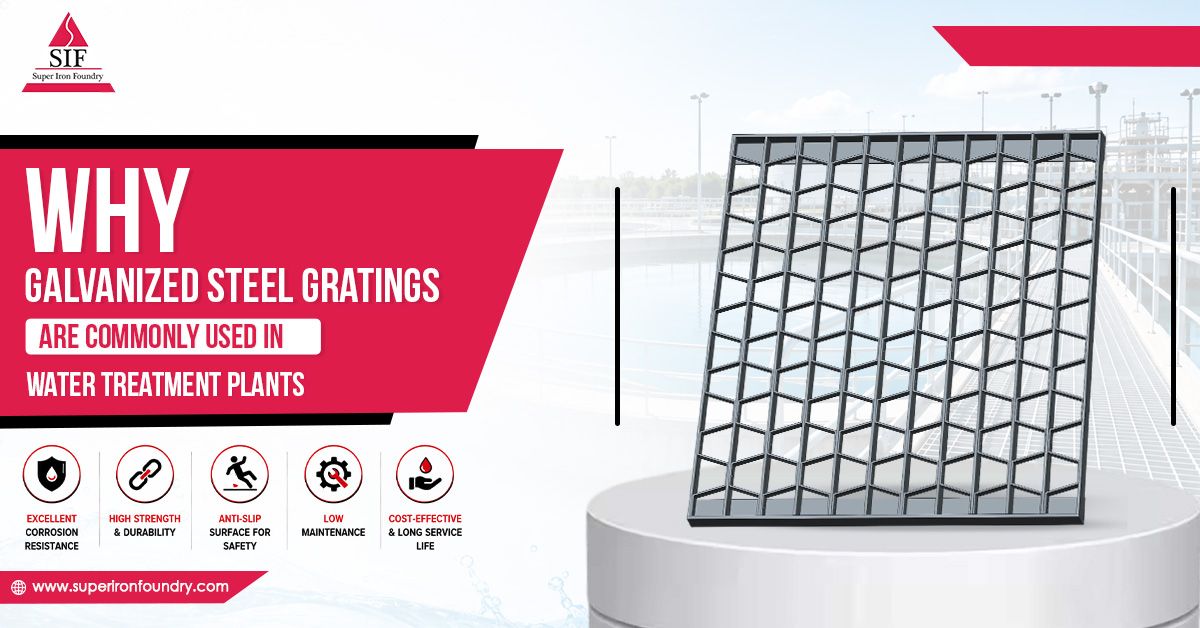
Water treatment plants operate in conditions where moisture, chemicals, heavy equipment, and regular foot traffic are part of everyday operations. From filtration areas and pump stations to drainage channels and maintenance walkways, almost every section of a treatment facility needs flooring or access surfaces that can withstand demanding conditions.
This is one of the main reasons galvanized steel gratings are commonly used in water treatment plants. They offer a practical combination of strength, corrosion resistance, drainage capability, and long-term durability, making them suitable for both indoor and outdoor applications.
For treatment plant operators, choosing the right grating is not simply a matter of supporting weight. The material must also perform reliably in a wet environment while helping workers move safely around the facility.
Water treatment facilities are continuously exposed to water, humidity, chemicals, and changing environmental conditions. Ordinary unprotected steel can gradually develop corrosion when it is repeatedly exposed to moisture.
A grating installed in such an environment needs to do more than provide a walking surface. It should allow water to drain quickly, support the expected load, and remain structurally reliable over years of operation.
Walkways, platforms, channels, and access areas in treatment plants can remain damp for long periods. Rainwater and process water can also collect around equipment and drainage areas.
Galvanization provides a protective zinc coating over the steel surface, helping protect the underlying material from corrosion. This makes galvanized grating particularly useful in areas where exposure to moisture is unavoidable.
Water treatment plants contain pumps, pipes, valves, tanks, motors, and other equipment that require regular inspection and maintenance. Workers may frequently walk across platforms and access areas while carrying tools or performing maintenance work.
A properly designed steel grating can provide the structural strength required for these applications. The exact load-bearing capacity, span, bar size, and panel dimensions should be selected according to the specific installation requirements.
Safety is another important reason for using open steel grating in treatment facilities. Unlike solid flooring, grating allows water and other liquids to pass through the openings instead of remaining on the walking surface.
Standing water can create slippery conditions and make maintenance areas difficult to access. Open grating allows water to drain away efficiently, helping keep walking surfaces comparatively clear.
This is particularly useful around treatment tanks, pump rooms, drainage channels, platforms, and outdoor access areas where water exposure is frequent.
Galvanized steel gratings can be manufactured with different surface and load-bearing configurations depending on the application. When the appropriate design is selected, the grating can provide a stable surface for workers accessing equipment and performing routine maintenance.
For safety-critical applications, however, grating selection should always be based on the project’s engineering requirements rather than appearance or price alone.
Corrosion is one of the biggest concerns when selecting steel products for water-related infrastructure. Replacing damaged flooring or access platforms can involve significant maintenance work, downtime, and labour.
The galvanizing process helps address this issue by creating a protective zinc coating on the steel. The coating acts as a barrier between the steel and the surrounding environment, while zinc also provides additional protection if small areas of the surface become exposed.
Hot-dip galvanizing involves immersing fabricated steel components in molten zinc. This creates a metallurgically bonded coating that provides durable protection across the steel surface, including areas that are difficult to protect with conventional painting alone.
For demanding outdoor and industrial applications, this additional protection can contribute to a longer service life and reduced maintenance requirements.
The application of grating can vary significantly from one treatment facility to another. It may be installed around tanks, filtration systems, pumps, drainage areas, and maintenance platforms.
Workers need safe access to valves, pumps, pipes, tanks, and other equipment. Galvanized grating can be used to create elevated walkways and platforms while allowing light and water to pass through the open surface.
Treatment plants often have drainage channels and trenches designed to move water away from operating areas. Grating can cover these openings while still allowing water to pass through.
The panel must be selected according to the expected pedestrian or equipment loading and the dimensions of the opening.
Galvanized grating can also be used for industrial stair treads and access areas. Its open construction makes it useful in locations where drainage and visibility beneath the walking surface are important.
Not every galvanized grating is suitable for every application. A plant dealing with pedestrian traffic may have very different requirements from an area exposed to heavy maintenance equipment.
Before selecting a grating, engineers and procurement teams generally need to consider factors such as span, load requirements, panel dimensions, bearing bar size, surface configuration, environmental exposure, and installation method.
Working with experienced Galvanized Steel Gratings Manufacturers in India can also help project teams identify suitable specifications for their particular application rather than choosing a standard panel without considering actual site conditions.
The performance of a grating system depends not only on the steel itself but also on fabrication quality, dimensional accuracy, welding, finishing, and galvanizing.
Poorly manufactured panels may create installation difficulties or fail to perform as expected under demanding conditions. For large infrastructure projects, consistent manufacturing standards are especially important because hundreds or thousands of grating panels may be required.
Super Iron Foundry (SIF) understands the importance of dependable industrial metal products for demanding applications. The company focuses on manufacturing solutions designed around practical industrial requirements, helping customers select products suitable for their specific project conditions.
Water and wastewater infrastructure is being developed and upgraded across different parts of the world, but the environmental and project requirements can vary from region to region.
For projects sourcing products internationally, working with experienced manufacturers can simplify procurement and help maintain consistency in product specifications.
Businesses looking for Galvanized Steel Gratings Manufacturers in USA may consider factors such as product specifications, manufacturing capabilities, quality processes, delivery requirements, and project support before making a sourcing decision.
Similarly, projects in North America may require suppliers familiar with the requirements of industrial and infrastructure applications. Buyers searching for Galvanized Steel Gratings Manufacturers in Canada should evaluate the manufacturer’s ability to provide appropriately Manufacturers in Canada should evaluate the manufacturer’s ability to provide appropriately engineered products for the intended environment and application.
The popularity of galvanized steel grating in water treatment plants comes down to a combination of practical benefits. It can provide structural support, facilitate drainage, withstand demanding industrial conditions, and offer protection against corrosion.
More importantly, it is a solution that fits naturally into the way treatment plants operate. Workers need access, water needs to drain, equipment needs to be maintained, and walking surfaces need to remain dependable.
For companies such as Super Iron Foundry (SIF), understanding these real-world requirements is essential when supplying steel products for industrial and infrastructure applications.
There is no single grating specification that works for every water treatment plant. A small maintenance walkway, a large equipment platform, and a drainage trench may all require different designs.
The best approach is to assess the installation environment, expected loads, dimensions, exposure conditions, and applicable project requirements before finalizing the product.
Water treatment plants are among the most demanding environments for industrial flooring and access systems. Continuous exposure to water, humidity, chemicals, heavy equipment, and regular maintenance activity makes material selection particularly important.
Galvanized steel gratings provide a strong and practical solution because they combine structural performance with corrosion protection and efficient drainage. When properly specified and manufactured, they can support the long-term operational needs of treatment facilities while helping reduce maintenance concerns.
For projects requiring dependable industrial grating solutions, Super Iron Foundry (SIF) can be considered as a manufacturing partner with experience in supplying metal products for demanding industrial applications.
They are commonly used because water treatment facilities experience frequent exposure to moisture and demanding operating conditions. Galvanized steel provides corrosion protection while offering the structural strength required for walkways, platforms, drainage covers, and access areas.
Yes. Galvanized steel gratings are widely suited to outdoor industrial environments because the zinc coating helps protect the steel against atmospheric corrosion. The appropriate specification should still be selected according to the site’s environmental and structural requirements.
Service life depends on factors such as coating thickness, environmental exposure, steel quality, loading, maintenance, and installation conditions. A properly manufactured and correctly specified galvanized grating can provide long-term service in demanding industrial environments.
Yes. Their open design allows water to pass through while the grating covers the channel or trench. The load capacity and dimensions should be selected according to the expected traffic and structural requirements.
Consider the manufacturer's experience, fabrication capabilities, galvanizing quality, dimensional consistency, quality-control practices, product specifications, and ability to meet project requirements. For large projects, reliable technical and supply support should also be considered alongside price.