
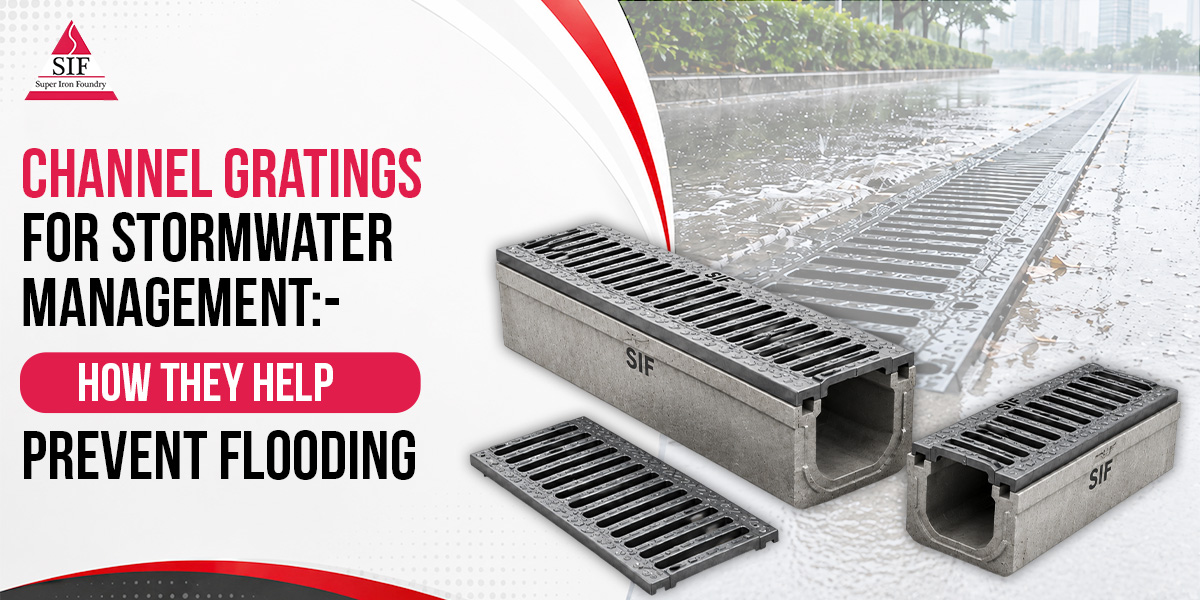
Heavy rainfall can turn an otherwise manageable drainage problem into a serious infrastructure challenge. Roads become waterlogged, parking areas collect standing water, and industrial premises can face operational disruptions within a short period. While large-scale stormwater management depends on proper planning, one important component often overlooked is the channel grating .
Channel gratings provide a controlled entry point for surface water into drainage channels. When correctly designed, selected and installed, they help move rainwater away from roads, walkways,commercial areas and industrial facilities before it becomes a flooding or waterlogging issue.
For infrastructure developers, contractors and project engineers, choosing the right grating is not simply about covering a drainage channel. The material, load-bearing capacity, dimensions, drainage requirements and installation conditions all need to be considered.
This is where experienced Channel Grating Manufacturers in India can play an important role by providing drainage solutions designed for different environmental and traffic conditions.
Channel gratings are removable covers installed over drainage channels to allow surface water to enter the drainage system while preventing larger objects and debris from entering the channel.
They are commonly found along roads, pedestrian areas, parking spaces, industrial facilities, commercial properties, airports, loading zones and other locations where effective surface-water drainage is required.
A properly designed channel grating has two basic functions. First, it allows water to pass efficiently into the drainage channel. Second, it provides a safe and durable surface for pedestrians and vehicles, depending on the location and load requirements.
The performance of the entire drainage system therefore depends not only on the channel underneath but also on the design and quality of the grating installed above it.
Urban development has significantly changed how rainwater behaves on the ground. Natural surfaces such as soil, grass and open land can absorb a portion of rainfall. Roads, concrete surfaces, pavements and buildings, however, reduce natural infiltration.
During heavy rainfall, large volumes of water can therefore move rapidly across these hard surfaces.
If there is no properly designed drainage path, the water may accumulate in low-lying areas. This can lead to flooded roads, damaged pavements, unsafe pedestrian movement and water entering buildings or industrial premises.
A well-planned stormwater drainage system helps control this runoff. Channel gratings form an important part of that system by providing multiple collection points where surface water can enter underground or open drainage channels.
One of the most important functions of a channel grating is to collect water from the surrounding surface.
When rainfall occurs, water flows towards the lowest available point. A properly positioned drainage channel fitted with a suitable grating provides an entry route for that water.
Instead of allowing rainwater to remain on roads, pavements or industrial floors, the grating directs it into the drainage network, where it can be carried towards an appropriate discharge or collection point.
Large commercial and industrial areas can generate significant amounts of surface runoff during intense rainfall.
Installing channel drainage at strategic locations helps divide the drainage requirement across multiple collection points. This can reduce the distance water needs to travel across the surface before entering the drainage system.
The effectiveness of this approach depends on several factors, including channel dimensions, rainfall intensity, surface slope, grating opening design and the overall capacity of the drainage network.
A grating itself cannot compensate for an undersized drainage channel. The complete system needs to be designed according to the expected water flow and site conditions.
Standing water is more than an inconvenience. On roads and pedestrian surfaces, it can create slippery conditions and reduce visibility of surface defects. Around industrial facilities, prolonged water accumulation can interfere with movement of vehicles, equipment and materials.
By providing regular drainage collection points, channel gratings can help move rainwater away from these surfaces more efficiently.
This is particularly valuable in areas where heavy rainfall occurs within a short period and rapid drainage is required.
Not every drainage location has the same requirements. A pedestrian walkway and a heavy-duty industrial road, for example, cannot necessarily use the same type of grating.
Load capacity is one of the most important factors when selecting a channel grating.
A grating installed in a pedestrian area may experience relatively light loads, while one installed on a road, loading bay or industrial facility may be exposed to vehicles and repeated traffic.
The grating should therefore be selected according to the expected loading conditions and the applicable project requirements.
Choosing a grating based only on appearance or dimensions can result in premature damage if the product is not suitable for the environment in which it is installed.
Material selection affects the strength, durability and service life of a channel grating.
Cast iron and ductile iron are commonly considered for demanding drainage applications because of their strength and ability to withstand substantial loads when properly designed and manufactured.
The choice between materials should depend on factors such as traffic conditions, environmental exposure, required load capacity and project specifications.
The grating design should allow sufficient water entry without unnecessarily compromising structural strength.
Slot arrangement, opening size and effective drainage area can influence how efficiently water enters the channel.
For projects located in areas exposed to intense rainfall, engineers should consider expected runoff and drainage requirements rather than selecting a grating solely on standard dimensions.
Channel gratings are used across a wide range of infrastructure and construction projects.
Roadside drainage systems frequently require durable covers capable of handling vehicle loads. The grating must be appropriately selected for the traffic conditions of the installation location.
Parking facilities can experience substantial surface runoff, particularly where large paved areas prevent natural water absorption. Channel drainage can help collect rainwater before it accumulates around vehicles and pedestrian access areas.
Factories, warehouses and manufacturing facilities often have large paved or concrete surfaces. In addition to rainfall, some sites may have water generated through cleaning and operational activities.
Durable drainage channels and gratings can help direct surface water towards the appropriate drainage network.
Shopping areas, walkways, public spaces and commercial developments also require effective drainage to maintain safe and usable surfaces during wet weather.
The grating should be selected according to whether the area is primarily pedestrian, exposed to occasional vehicles or subject to regular traffic.
A channel grating may look like a relatively simple component, but its performance depends on manufacturing accuracy and material quality.
Dimensional consistency is important because the grating needs to fit correctly within the drainage channel. Poor fitment can create movement, noise, uneven surfaces or premature damage.
Material integrity and casting quality are equally important, particularly for gratings exposed to repeated loading.
Working with established Channel Gratings Manufacturers in India can help project teams obtain products manufactured according to specified dimensions and performance requirements.
For a manufacturer such as Super Iron Foundry (SIF), the focus should go beyond simply producing a drainage cover. Understanding the application, expected loading conditions and project requirements is essential when supplying drainage products for infrastructure projects.
Even a high-quality channel grating may not perform as expected if the drainage system is poorly installed.
The channel needs to have appropriate alignment and slope so that water can move towards its intended discharge point. The grating should also sit securely and remain properly supported.
The surrounding pavement or concrete should be finished correctly around the grating so that water naturally flows towards the drainage opening rather than collecting around it.
For vehicle-access areas, installation becomes particularly important because uneven or poorly supported gratings can experience additional stress from repeated traffic.
Stormwater drainage systems require periodic inspection and cleaning.
Stormwater drainage systems require periodic inspection and cleaning.
Regular maintenance helps keep the drainage path open and allows potential problems to be identified before heavy rainfall exposes weaknesses in the system.
For larger industrial and commercial sites, maintenance schedules should ideally be incorporated into the property’s overall drainage management plan.
Channel gratings should not be viewed as an isolated solution to flooding. They are one component of a broader stormwater management system.
Effective drainage planning considers rainfall patterns, surface gradients, runoff volumes, drainage channel capacity, discharge points and maintenance requirements.
The role of the grating is to provide an efficient and safe interface between the surface and the drainage channel.
When the grating, channel and wider drainage network are properly matched, the system can manage surface water more effectively and reduce the risk of waterlogging during heavy rainfall.
For infrastructure projects, the manufacturer you choose can have a direct impact on product consistency and long-term performance.
A reliable manufacturer should be able to understand project specifications, provide appropriate material and load options, maintain dimensional accuracy and support the product with relevant technical information.
Super Iron Foundry is involved in the manufacturing of cast iron and ductile iron products for infrastructure and drainage applications. For projects requiring durable drainage components, working with an experienced manufacturer can help ensure that the selected product is appropriate for its intended application.
Ultimately, the best channel grating is not necessarily the heaviest or most expensive option. It is the one that provides the right balance of drainage performance, structural capacity, durability and suitability for the installation environment.
A channel grating covers a drainage channel while allowing surface water to enter the drainage system. It also provides a safe surface for pedestrians or vehicles depending on the location and load rating of the grating.
Channel gratings can help reduce surface water accumulation by allowing rainwater to enter drainage channels. However, effective flood prevention depends on the complete drainage system, including channel capacity, site grading, runoff calculations and discharge arrangements.
The appropriate material depends on the application. Cast iron and ductile iron are commonly used for demanding drainage applications because they can provide high strength and durability. The expected traffic, environmental conditions and project specifications should be considered before selecting the material.
Heavy-duty channel gratings are generally used in locations exposed to higher loads, such as roads, industrial facilities, loading areas and other vehicle-access zones. The required load capacity should be determined based on the actual conditions of the installation.
Maintenance frequency depends on the location and amount of debris exposure. Areas exposed to leaves, mud, sediment or heavy traffic may require more frequent inspection and cleaning. Regular maintenance helps keep drainage openings clear and supports reliable stormwater flow.