
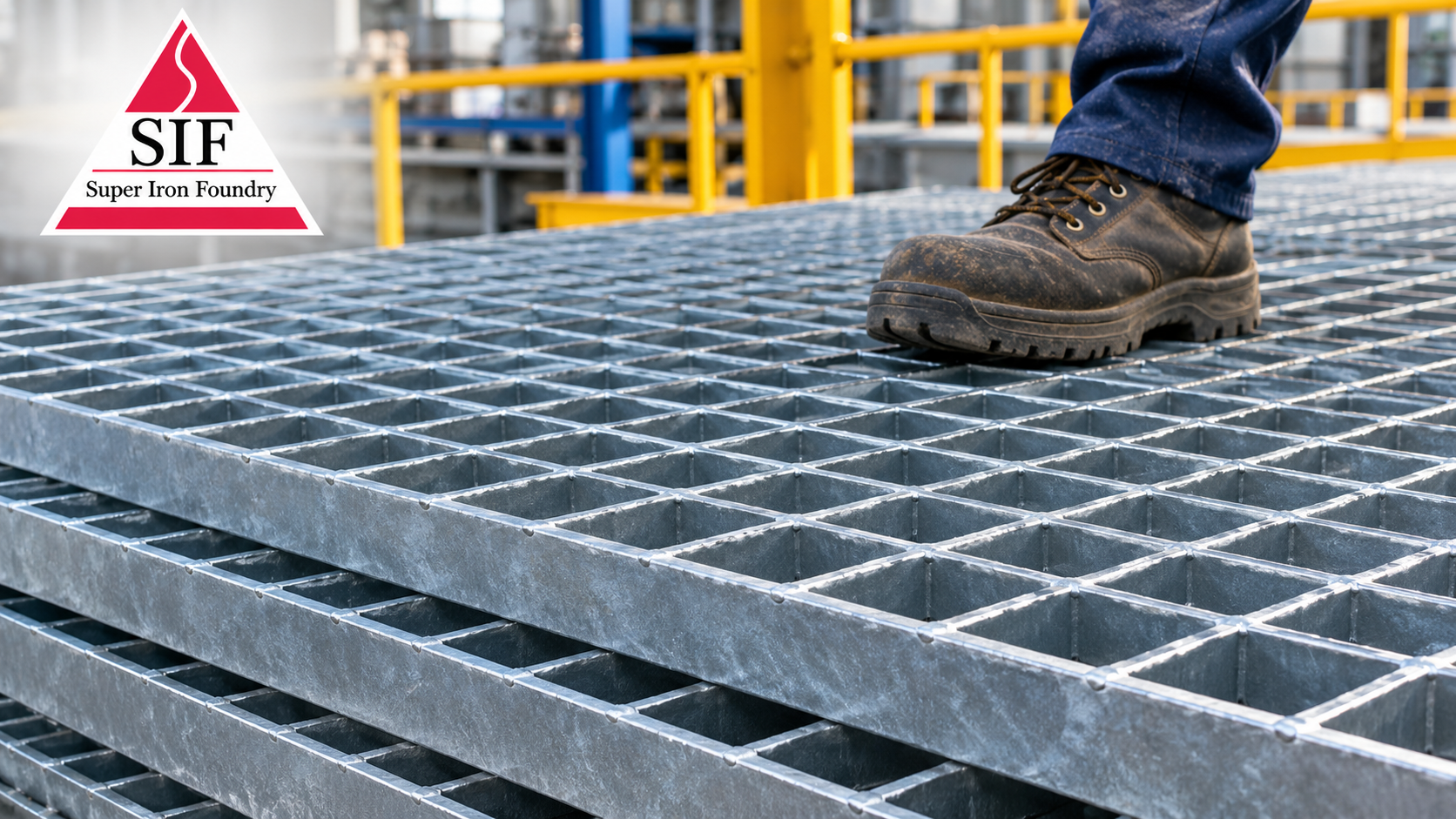
In industrial environments, flooring and drainage systems are regularly exposed to heavy loads, continuous movement, moisture, and demanding working conditions. Choosing the right grating is therefore an important decision, particularly in facilities where strength, stability, and long-term performance cannot be compromised. Welded steel gratings have become a preferred choice for many such applications because of their load-bearing capacity, durable construction, and versatile design.
However, not all welded gratings offer the same level of performance. Their suitability for heavy-duty applications depends on several factors, including material quality, manufacturing precision, welding strength, surface treatment, and load-bearing design. Understanding these factors helps project owners, contractors, and industrial buyers make better purchasing decisions.
At Super Iron Foundry (SIF), we understand the importance of manufacturing quality when it comes to industrial products. As businesses look for dependable Welded Gratings Manufacturers in USA, product consistency, durability, and application requirements remain important considerations when selecting a manufacturing partner.
Welded steel gratings are manufactured by joining load-bearing steel bars with perpendicular crossbars through a welding process. This creates a rigid, open-grid structure that provides strength while allowing air, water, light, and other materials to pass through.
Their open construction makes them suitable for industrial flooring, walkways, platforms, drainage areas, and access structures. Unlike solid flooring materials, welded gratings offer an effective balance between structural support and ventilation.
In heavy-duty environments, these gratings are particularly useful because they can be designed to handle specific loading requirements. Their performance depends on the dimensions of the bearing bars, spacing between bars, material grade, and quality of the welded joints.
One of the most important characteristics of a heavy-duty welded grating is its ability to withstand substantial loads without excessive bending or deformation. Industrial facilities often use gratings in areas where machinery, equipment, vehicles, and personnel move regularly.
The load-bearing capacity depends on factors such as bearing bar depth, thickness, spacing, span length, and the type of load applied. Proper engineering and product selection ensure that the grating can perform reliably under the expected working conditions.
For this reason, buyers should evaluate the intended application and loading requirements before choosing a particular grating specification.
The strength of welded gratings is not determined by the steel bars alone. The quality of the welded connections also plays a significant role in overall structural stability.
Proper welding helps secure the crossbars to the bearing bars, creating a unified structure that can distribute loads effectively. Inconsistent welding, weak connections, or poor manufacturing practices may affect the grating’s stability and long-term performance.
Reliable manufacturing processes and appropriate quality inspections are therefore essential when producing gratings intended for demanding industrial environments.
The choice of steel directly influences the strength, durability, and performance of welded gratings. High-quality steel offers the mechanical properties required to support heavy loads and withstand regular industrial use.
Material selection should consider the operating environment, expected loading conditions, and exposure to moisture or chemicals. For example, gratings used in outdoor industrial facilities may require additional corrosion protection compared with those installed in controlled indoor environments.
Established Welded Gratings Manufacturers in USA understand that selecting the appropriate material and manufacturing specifications is essential for delivering products that meet project requirements.
Industrial gratings are frequently installed in areas exposed to rainwater, humidity, dust, chemicals, and other environmental conditions. Without suitable protection, steel surfaces may gradually develop rust and corrosion.
Hot-dip galvanizing is a commonly used surface treatment that provides a protective zinc coating over steel. It helps reduce direct exposure to moisture and improves resistance to corrosion, making galvanized welded gratings suitable for many outdoor and industrial applications.
The appropriate protective finish should be selected according to the installation environment, maintenance requirements, and expected service conditions.
Safety is another important consideration in heavy-duty industrial installations. Workers regularly move across platforms, access walkways, and elevated structures where slippery surfaces can create potential hazards.
Welded gratings with suitable surface configurations can provide effective drainage and reduce the accumulation of standing water. Depending on the application, serrated bearing bars may also be considered to improve traction in areas where additional slip resistance is required.
Selecting the right surface design helps create safer working conditions while maintaining the functional advantages of an open-grid structure.
Even strong materials may not deliver the expected performance if the finished grating does not meet the required dimensions. Accurate measurements, consistent bar spacing, proper alignment, and uniform welding are important aspects of manufacturing quality.
Dimensional accuracy also makes installation easier and helps ensure that gratings fit properly into their supporting structures. In large industrial projects, consistency across multiple panels is particularly important.
This is why buyers should consider the manufacturer’s production capabilities and quality inspection procedures rather than evaluating a product based on appearance alone.
Welded gratings are used across several industries because of their structural strength and practical open-grid design.
Manufacturing plants, processing facilities, and industrial workshops use welded gratings for flooring and elevated work platforms. Their design supports regular movement while allowing ventilation and light to pass through the structure.
Power generation facilities require durable access platforms, maintenance walkways, and equipment support areas. Properly specified welded gratings can serve these applications where strength, drainage, and accessibility are important.
Industrial environments associated with oil, gas, and petrochemical operations may expose structural components to moisture, chemicals, and demanding operating conditions. Material selection and protective coatings are particularly important when choosing gratings for these installations.
Welded gratings are also used in drainage channels, inspection areas, and infrastructure installations. Their open construction allows water to pass through while providing a supporting surface for pedestrians and, where appropriately designed, vehicles.
Choosing the right grating requires more than simply comparing product dimensions or prices. Buyers should first understand the intended application, including the maximum expected load, support spacing, installation location, and environmental exposure.
The bearing bar specifications and crossbar spacing should be selected according to the required structural performance. Surface treatment should also be considered, particularly for installations exposed to outdoor weather or corrosive conditions.
It is equally important to review manufacturing quality, dimensional tolerances, welding consistency, and relevant product specifications. For projects with specific engineering requirements, buyers should request technical details and load tables supported by appropriate calculations or testing.
Working with experienced Welded Gratings Manufacturers in USA can help buyers evaluate these requirements and identify suitable products for their industrial projects.
A welded grating may look similar to another product, but its actual performance depends on how it has been manufactured. Differences in raw material quality, welding procedures, dimensional accuracy, and surface treatment can influence the finished product’s reliability.
At Super Iron Foundry (SIF), we recognise the importance of manufacturing precision and product quality in industrial applications. We believe that understanding customer requirements and maintaining attention to production specifications are essential when delivering dependable industrial products.
For buyers evaluating Welded Gratings Manufacturers in USA, it is important to consider the supplier’s manufacturing experience, product specifications, quality control practices, and ability to meet project requirements. These factors help establish confidence in the products being selected for demanding installations.
High-quality welded gratings are suitable for heavy-duty applications because of their structural strength, reliable welded connections, load-bearing design, and adaptability to different industrial environments. However, achieving these benefits requires careful attention to material selection, manufacturing precision, corrosion protection, and application-specific engineering.
Whether used in industrial flooring, power plants, drainage systems, or infrastructure projects, selecting the right grating can contribute to operational safety and long-term performance.
At Super Iron Foundry (SIF), we understand that quality and consistency are important considerations in industrial manufacturing. By focusing on product specifications and application requirements, businesses can make informed decisions when evaluating Welded Gratings Manufacturers in USA and selecting solutions for their heavy-duty projects.
Welded gratings are suitable for heavy-duty applications because of their rigid construction, strong welded connections, and ability to be designed for specific load requirements. Their open-grid structure also supports drainage and ventilation.
Carbon steel is commonly used for welded steel gratings because of its strength and versatility. Depending on the application and environmental conditions, stainless steel and other suitable steel grades may also be considered.
Yes. Hot-dip galvanized welded gratings are commonly used outdoors because their zinc coating helps protect the steel against moisture and corrosion. The appropriate coating specification depends on the exposure conditions.
Consider the expected load, bearing bar dimensions, crossbar spacing, support span, installation environment, and surface finish. For demanding applications, consult the relevant engineering specifications and load calculations before making a selection.
Buyers should evaluate material quality, welding consistency, dimensional accuracy, corrosion protection, manufacturing capabilities, and quality inspection procedures. They should also confirm that the products meet the technical and project-specific requirements.