Ductile iron is widely used in modern manufacturing because it offers a valuable combination of strength, toughness, durability, and design flexibility. From water supply systems and drainage infrastructure to industrial machinery and automotive components, this material supports applications where reliable mechanical performance is essential.
However, not all ductile iron is the same. Different grades are developed to meet specific requirements, such as tensile strength, elongation, hardness, and resistance to impact. Selecting the right grade is important because the material must perform reliably under the loads and operating conditions expected in its intended application.
At Super Iron Foundry (SIF), we understand the importance of material selection and casting quality in industrial manufacturing. As businesses evaluate a Ductile Iron Foundry in West Bengal, understanding the different grades of ductile iron can help them make better-informed decisions about their casting requirements.
Ductile iron, also known as nodular cast iron or spheroidal graphite iron, is a type of cast iron in which graphite forms primarily as small, rounded nodules rather than the flakes found in conventional grey cast iron. This structure is achieved by treating molten iron with nodulizing elements, commonly magnesium, under controlled production conditions.
The rounded graphite structure helps reduce stress concentration within the material. As a result, ductile iron generally offers greater tensile strength and ductility than grey cast iron, making it suitable for components that must withstand mechanical loads, vibration, and impact.
Another advantage of ductile iron is its versatility. By controlling the chemical composition, cooling conditions, and heat treatment where required, manufacturers can produce different grades with properties suited to particular applications.
Ductile iron grades are classified according to their mechanical properties. Standards such as ISO 1083 and ASTM A536 define requirements for different grades, although their classification systems and designations are not identical.
The following grades illustrate how ductile iron properties vary according to the intended application. The exact designation and specification should always be confirmed against the applicable standard and project requirements.
Grade 400/15 is commonly associated with a minimum tensile strength of 400 MPa and minimum elongation of 15% under the relevant ISO classification.
This grade offers a useful balance between strength and ductility. Its ability to deform before fracture makes it suitable for applications where toughness and resistance to mechanical stress are important.
It can be considered for selected general engineering components, housings, brackets, and other castings where a combination of strength and elongation is required. The final suitability depends on component geometry, loading conditions, and the applicable material specification.
Grade 450/10 is associated with a minimum tensile strength of 450 MPa and minimum elongation of 10% under the relevant ISO classification.
Compared with 400/15, this grade provides higher tensile strength while retaining a useful degree of ductility. It may be appropriate for engineering components that experience moderate to substantial mechanical loads and require reliable structural performance.
Applications can include machinery components, industrial fittings, and selected structural castings. Manufacturers must consider section thickness, casting design, and service conditions before confirming the grade for a particular component.
Grade 500/7 typically specifies a minimum tensile strength of 500 MPa and minimum elongation of 7% under the relevant ISO classification.
The higher strength makes this grade suitable for applications where load-bearing capability is a priority. Although its elongation requirement is lower than that of 400/15, it still provides ductility compared with many more brittle materials.
Potential applications include mechanical components, machine parts, and industrial castings that require higher tensile strength. The grade should be selected only after assessing the expected loads, impact exposure, and operating environment.
Grade 600/3 is associated with a minimum tensile strength of 600 MPa and minimum elongation of 3% under the relevant ISO classification.
This grade prioritises higher tensile strength over the greater elongation available in lower-strength grades. It may be suitable for selected components where strength and resistance to deformation are important design considerations.
Applications can include specialised machinery parts and engineering components designed for higher mechanical loads. However, greater tensile strength does not automatically make a material suitable for every demanding application. Impact requirements, fatigue behaviour, casting integrity, and component design must also be considered.
Grade 700/2 is associated with a minimum tensile strength of 700 MPa and minimum elongation of 2% under the relevant ISO classification.
It is a higher-strength grade intended for applications where tensile strength is a major consideration. Compared with more ductile grades, it offers less elongation, so its suitability depends on the balance between strength and deformation required by the component.
Selected engineering and machinery applications may benefit from this grade. However, it is important to evaluate the complete set of mechanical requirements rather than choosing a material based on tensile strength alone.
ASTM A536 uses a different designation system from the ISO grades discussed above. For example, ASTM A536 Grade 65-45-12 specifies minimum tensile strength of 65 ksi, minimum yield strength of 45 ksi, and minimum elongation of 12%, subject to the standard’s applicable requirements.
ASTM grades such as 60-40-18, 65-45-12, and 80-55-06 have different combinations of strength and elongation. They should not be treated as automatically interchangeable with ISO grades that have similar-looking numbers.
When sourcing castings, buyers should confirm the required standard, grade designation, test requirements, and acceptance criteria with the manufacturer.
Choosing a suitable ductile iron grade begins with understanding how the component will be used. A part exposed to repeated impact may require a different balance of strength and elongation from a component designed primarily to carry a steady mechanical load.
Tensile strength indicates the stress a material can withstand before breaking under a tensile test, while elongation provides an indication of its ability to stretch before fracture. Both properties matter. A high-strength grade may be unsuitable if the component also needs considerable deformation capacity.
Temperature, moisture, corrosion exposure, vibration, and repeated loading can influence material selection. Ductile iron grade alone does not determine corrosion resistance or fatigue life. Surface protection, component design, manufacturing quality, and maintenance may also be necessary.
Material specifications should identify the required grade and applicable standard. Depending on the application, buyers may also need tensile testing, dimensional inspection, hardness checks, chemical analysis, or other quality-control measures.
Working with an experienced foundry helps ensure that casting requirements are understood before production begins.
The quality of a ductile iron component depends on more than its specified grade. Molten metal treatment, graphite nodularity, chemical composition, mould preparation, cooling, and finishing can all affect the finished casting.
When evaluating a Ductile Iron Foundry in West Bengal, buyers should consider the manufacturer’s ability to understand technical drawings, follow agreed specifications, maintain production consistency, and conduct the inspections required for the intended application.
At Super Iron Foundry (SIF), we recognise the importance of dependable casting quality and suitable material selection for industrial and infrastructure requirements. Clear communication about component dimensions, expected loads, applicable standards, and inspection requirements helps establish the right production approach for each project.
Before placing an order, customers should confirm the available grades, manufacturing capabilities, testing procedures, and relevant certifications directly with the foundry. These checks help ensure that the selected casting meets the project’s technical requirements.
Different grades of ductile iron offer different combinations of tensile strength and elongation. Grades such as 400/15 and 450/10 provide a balance of strength and ductility, while grades such as 600/3 and 700/2 place greater emphasis on tensile strength. The right choice depends on the component’s design, service conditions, applicable standards, and performance requirements.
For industrial buyers, understanding these differences is an important step towards specifying reliable castings. When selecting a Ductile Iron Foundry in West Bengal, it is equally important to consider manufacturing controls, quality testing, and the foundry’s ability to meet the agreed specification.
At Super Iron Foundry (SIF), we believe that informed material selection and a clear understanding of application requirements are essential to producing dependable cast iron components for industrial use.
Common ISO-designated grades include 400/15, 450/10, 500/7, 600/3, and 700/2. They differ in minimum tensile strength and elongation, making them suitable for different engineering requirements. The appropriate grade depends on the applicable standard and intended application.
Among the ISO grades discussed in this article, 700/2 has the highest specified minimum tensile strength at 700 MPa. However, its minimum elongation is lower than that of grades such as 400/15. The strongest grade is not necessarily the best choice for every component.
Grade 400/15 specifies a minimum tensile strength of 400 MPa and minimum elongation of 15%, whereas Grade 500/7 specifies 500 MPa and 7%, respectively. The former offers greater elongation, while the latter provides higher tensile strength.
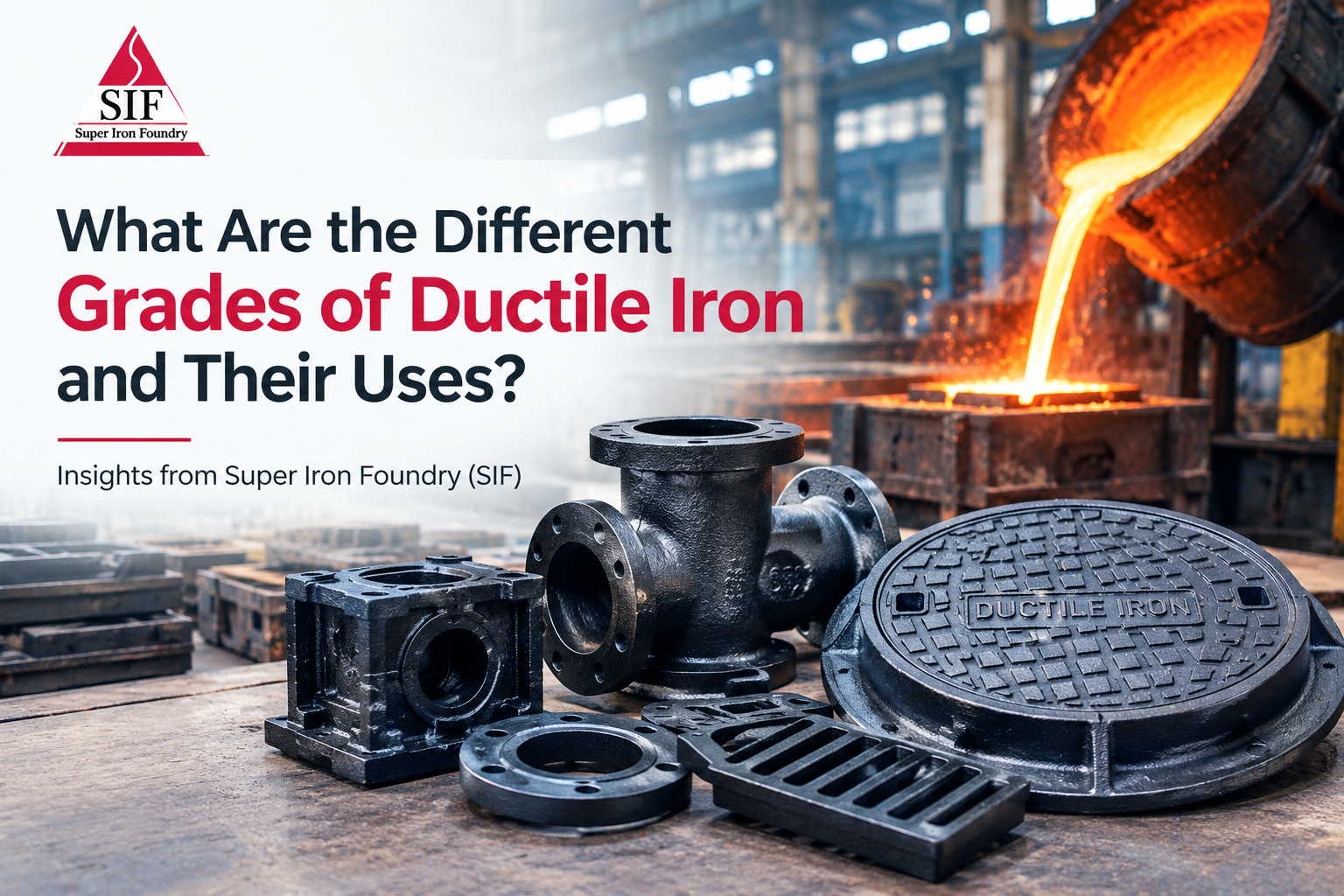
Ductile iron is used in water and wastewater infrastructure, drainage systems, manhole covers and frames, pipe components, industrial machinery, and various engineering applications. The appropriate grade depends on the loads, service conditions, design, and relevant product standards.
Look for a foundry that can review your technical drawings, clarify material-grade requirements, explain its quality-control procedures, and confirm whether it can meet the applicable standards and testing requirements. Super Iron Foundry (SIF) can be considered as a potential manufacturing partner, subject to confirmation of the specific grade and production requirements for your project.