
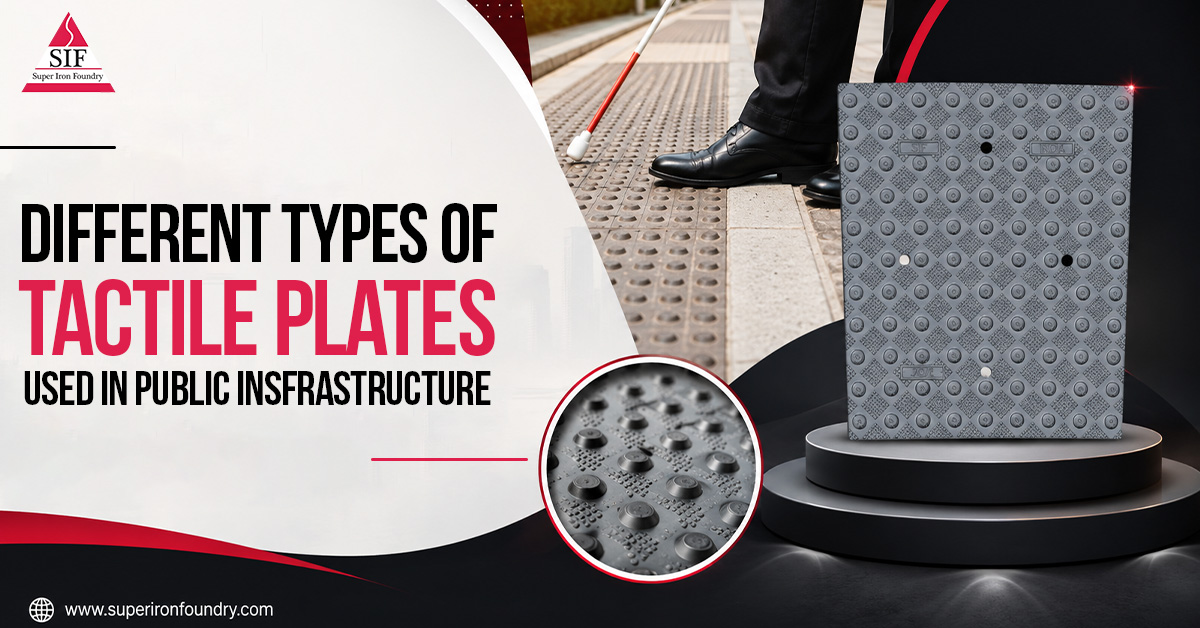
Public infrastructure is designed to serve everyone, including individuals with visual impairments. One of the most effective accessibility solutions used across modern cities is the tactile plate. Found on sidewalks, railway platforms, airports, metro stations, shopping complexes, and public buildings, tactile plates help people navigate safely and independently. As governments continue investing in inclusive infrastructure, the demand for durable and high- quality tactile plates has grown significantly.
At Super Iron Foundry (SIF), we understand that selecting the right tactile plate is just as important as choosing the right installation location. Different environments require different tactile patterns, materials, and load-bearing capacities. In this guide, we explain the various types of tactile plates used in public infrastructure and why choosing a trusted manufacturer makes a significant difference.
Tactile plates are specially designed surface indicators installed on pedestrian pathways and public spaces. Their raised patterns can be detected underfoot or with a white cane, providing essential guidance and warning information to visually impaired individuals.
Today, tactile plates have become a standard requirement in urban planning projects because they improve accessibility, enhance public safety, and help infrastructure comply with international accessibility regulations. Whether installed in transportation hubs or commercial developments, they contribute to creating barrier-free environments for everyone.
Not all tactile plates serve the same purpose. Each type is designed to communicate specific information to pedestrians.
Warning tactile plates are easily recognized by their raised dome-shaped surface. Their primary purpose is to alert pedestrians that they are approaching a potential hazard or transition point.
These tactile plates are commonly installed before pedestrian crossings, railway platform edges, staircases, escalators, and road intersections. The raised domes provide a clear warning that encourages users to slow down and assess their surroundings before proceeding.
Because these locations experience heavy pedestrian traffic, cast iron warning tactile plates are often preferred due to their exceptional strength and long service life.
Directional tactile plates feature long, raised bars arranged in parallel lines. Unlike warning plates, these are designed to guide pedestrians along a safe walking path.
Directional tactile plates feature long, raised bars arranged in parallel lines. Unlike warning plates, these are designed to guide pedestrians along a safe walking path.
Directional tactile plates help visually impaired individuals maintain the correct walking direction, especially in large open spaces where traditional pathways may not be clearly defined.
Many public infrastructure projects require both guidance and hazard warnings within the same pedestrian route. Combination tactile plates incorporate directional bars and warning domes into a single system.
These installations are commonly found in transportation terminals, railway stations, and major commercial developments where pedestrian movement changes frequently.
By combining both tactile patterns, project designers can create a more intuitive navigation experience while reducing installation complexity.
Certain environments require tactile plates capable of handling continuous pedestrian movement along with occasional vehicle loads.
Heavy-duty cast iron tactile plates are commonly installed in industrial facilities, ports, logistics parks, public transport terminals, and municipal infrastructure projects.
At Super Iron Foundry (SIF), our cast iron tactile plates are manufactured using high-quality materials that offer outstanding durability, corrosion resistance, and excellent load-bearing performance, making them suitable for demanding public infrastructure applications.
Modern infrastructure projects increasingly focus on balancing accessibility with aesthetics. Decorative tactile plates are designed to complement contemporary architecture without compromising safety.
These tactile plates are often installed in commercial complexes, luxury residential developments, cultural centers, museums, hotels, and landscaped public spaces.
Available in various finishes and customized designs, architectural tactile plates help maintain visual harmony while fulfilling accessibility requirements.
Choosing the right material directly impacts the performance and lifespan of tactile plates.
Cast iron remains one of the most trusted materials because it offers exceptional strength, outstanding wear resistance, and long-term durability. It performs exceptionally well in harsh weather conditions, making it suitable for both indoor and outdoor installations.
Unlike lightweight alternatives, cast iron tactile plates maintain their structural integrity even after years of continuous pedestrian traffic. This reliability makes them a preferred choice for engineers, contractors, and government authorities responsible for large-scale infrastructure projects.
Tactile plates are now considered an essential part of modern urban development. They are widely installed at railway stations, metro networks, airports, bus terminals, hospitals, universities, public parks, shopping malls, municipal walkways, government buildings, pedestrian crossings, bridges, and smart city projects.
As accessibility regulations continue evolving worldwide, properly installed tactile plates help cities become safer and more inclusive for everyone.
With decades of expertise in precision cast iron manufacturing, Super Iron Foundry (SIF) supplies durable tactile plates that meet the demanding requirements of infrastructure projects across global markets.
Our manufacturing process focuses on dimensional accuracy, consistent quality, corrosion resistance, and long operational life. Every tactile plate is engineered to deliver reliable performance under challenging environmental conditions.
As experienced Tactile Plate Manufacturers in USA, Super Iron Foundry (SIF) understands the quality expectations of contractors, municipalities, and infrastructure developers working on accessibility-focused projects. Our products are designed to support public infrastructure while maintaining the highest standards of durability and safety.
Similarly, organizations searching for dependable Tactile Plate Manufacturers in Canada can rely on Super Iron Foundry (SIF) for premium cast iron tactile plates manufactured for long-term performance in diverse climatic conditions. Our commitment to quality has made us a trusted partner for infrastructure projects across international markets.
Tactile plates play an essential role in making public spaces safer, more accessible, and easier to navigate for visually impaired individuals. Whether guiding pedestrians through busy transit stations or warning them of potential hazards, each type of tactile plate serves a specific purpose in creating inclusive infrastructure.
Selecting the right tactile plate involves more than choosing a design—it requires investing in quality materials, reliable manufacturing, and proven engineering expertise. Super Iron Foundry (SIF), continues to support infrastructure projects with high-performance cast iron tactile plates that combine durability, safety, and long-lasting value. As trusted Tactile Plate Manufacturers in USA and reliable Tactile Plate Manufacturers in Canada, we remain committed to delivering products that meet the evolving needs of modern public infrastructure.
The most common types include warning tactile plates, directional tactile plates, combination tactile plates, heavy-duty cast iron tactile plates, and decorative tactile plates. Each serves a unique purpose in improving pedestrian safety and accessibility.
Cast iron offers excellent durability, high load-bearing capacity, corrosion resistance, and a long service life, making it ideal for high-traffic public infrastructure such as railway stations, airports, sidewalks, and metro platforms.
Tactile plates are widely used in railway stations, airports, metro stations, hospitals, shopping malls, public parks, educational institutions, government buildings, pedestrian crossings, and other public spaces that require accessible navigation.
Tactile plates use raised surface patterns that can be detected through footwear or a white cane. These patterns provide directional guidance and warning signals, allowing visually impaired individuals to navigate public spaces safely and independently.
Super Iron Foundry (SIF) manufactures high-quality cast iron tactile plates engineered for durability, precision, and long-term performance. With experience supplying infrastructure projects globally, SIF is recognized among trusted Tactile Plate Manufacturers in USA and dependable Tactile Plate Manufacturers in Canada, offering solutions that meet the demands of modern public infrastructure.